The Ultimate Guide to Electrician Career Paths in 2026

SpliceJobs Team
Published on 2/19/2026
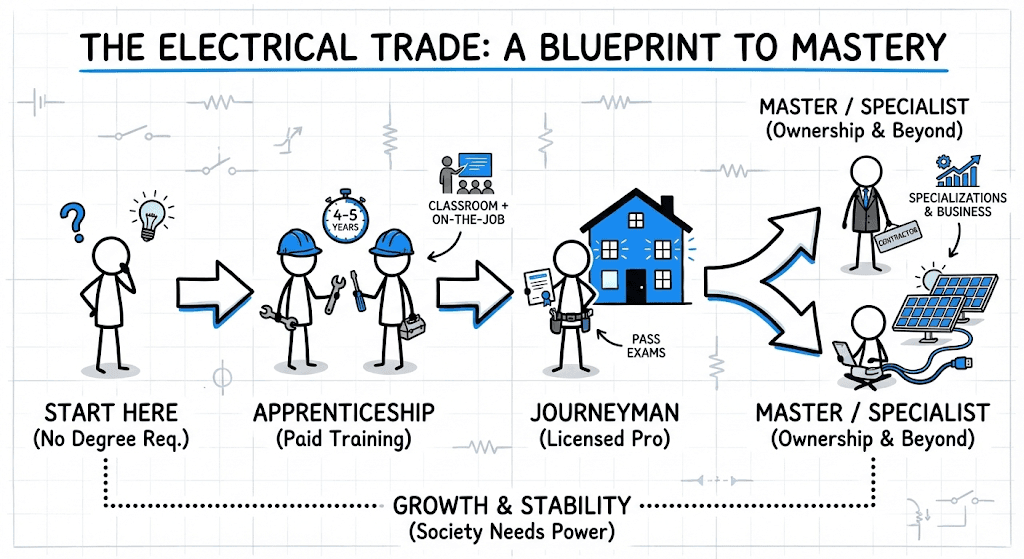
If you want a career that demands sharp problem-solving skills and rewards you with exceptional pay, the electrical trade is one of the best paths available. This field offers unparalleled job security because society relies entirely on the electrical infrastructure we build and maintain. Whether you are troubleshooting complex circuitry in a commercial high-rise or wiring a residential smart home, the work is highly technical and physically engaging. This comprehensive resource serves as your definitive electrician apprenticeship guide to help you understand the journey from a green helper to a seasoned master of the trade.
Understanding the Reality of the Work
Before you commit to this career, it is crucial to understand what the daily grind actually looks like. According to the Bureau of Labor Statistics, the electrical trade is growing rapidly and offers a highly stable career trajectory. Electricians install, maintain and repair the critical infrastructure that powers our modern world. They routinely handle electrical power communications and control systems across homes, businesses, and factories.
If you are seriously asking yourself, "is being an electrician a good job?", the answer depends entirely on your willingness to tackle both intense mental problem-solving and serious physical challenges.
Before you invest in your first set of insulated screwdrivers and wire strippers, you need to know exactly what you are signing up for. If you want the unvarnished truth about the trade, check out our honest review on whether becoming an electrician is a good career to see a real breakdown of the daily grind, the actual pay scale, and the physical toll.
Whether you install and maintain wiring in a commercial high-rise or maintain and repair electrical grids in an industrial plant, the physical demands are real. You will spend hours on your feet, work in tight crawlspaces, and pull heavy copper wiring through complex piping systems. You will also find yourself installing specialized communications lighting and security grids.
Once you accept the physical reality of the job, the next logical question is about the timeline. Getting to that top tier pay grade takes a massive commitment to on the job training. If you are ready to map out your career, check out our realistic breakdown of how long it takes to become an electrician.
Despite the hard work, the financial payoff and career stability are massive. If you want to see the projected growth for the trade, you can review the national data regarding the electrician career path to understand the long-term outlook. You are entering an industry that cannot be outsourced and is highly resistant to economic downturns.
Is Being an Electrician Hard?
If you ask ten different journeymen this question, you will get ten different answers. The reality is that the difficulty changes depending on the day, the project, and your own strengths. It is a job that challenges your brain just as much as your back.
The hardest part for many beginners is not the heavy lifting. It is the mental focus required to work safely. When you are wiring a panel or tracing a short circuit, you cannot afford to daydream. A mistake in this trade does not just mean ruining a piece of material; it can mean a serious safety hazard for you or the crew around you.
On the physical side, you will spend your days working on your feet, climbing up and down ladders, and squeezing into awkward positions. Your hands will get calloused, and your muscles will be sore when you first start out. But if you enjoy active work and like solving puzzles under real world conditions, the challenges become manageable.
Knowing the long term outlook is a great first step, but it usually sparks a deeper question about the daily training. Before you start hunting for open positions, you need a realistic look at the actual learning curve. If you want a full breakdown of the math requirements, the physical grit needed, and the code exams, read our deep dive on how hard it is to become an electrician. It will show you exactly what it takes to survive the apprentice years so you can plan your next move with confidence.
How Do I Land a Job Without a Degree?
One of the biggest misconceptions about high-paying jobs is that they all require a four-year college degree. In the trades, your classroom is the job site. You do not need a university diploma to get started. If you are wondering how to become an electrician, the standard entry requirement is simply a high school diploma, or a recognized school diploma or equivalent.
Still on the fence about whether to enroll in university or head straight to the job site? If you want to see exactly how an apprenticeship stacks up against a traditional four-year college track, we have the answers. Discover why skipping massive student debt and getting paid to learn the trade is the smartest financial move you can make. Find out exactly what is required to start pulling wire in our full breakdown: Do You Need a College Degree to Be an Electrician?
When searching for electrician jobs no experience required, your best option is to start at the bottom. Finding an electrician apprentice job is the best way to start your journey. When you first start, your duties will be basic but essential. You will organize the work truck, fetch tools, measure and cut conduit, and assist journeymen with pulling wire. It is about learning the terminology and the flow of a job site. Before entering an apprenticeship or trade school color vision is an essential physical requirement you must meet to safely identify wires.
A career as an electrician offers great pay, but you need to budget for your training first. Tuition, tools, and textbooks can add up quickly if you choose the traditional classroom route over an apprenticeship. If you are weighing your education options, take a look at our complete breakdown on how much trade school for an electrician coststo see exactly what you will spend and how soon you will see a return on your investment.
Stuck in the classic "need experience to get a job, need a job to get experience" loop?
Do not let that keep you off the tools. If you are completely green but ready to work hard, merit shop contractors and union halls are actively hiring reliable helpers to keep their sites moving. Learn exactly how to bypass the hiring trap, build your starter tool belt, and land your first role in our dedicated breakdown.
Ready to trade the college lecture hall for a high-paying jobsite? Read our complete, step-by-step guide on How to Land an Electrician Job Without a Degree to learn exactly how to secure an apprenticeship, choose the right starter tools, and build a lucrative career from the ground up.
The Core of the Trade: Your Apprenticeship
The true foundation of your career is the apprenticeship. This is a structured four-to-five-year period of paid on the job training where you earn a paycheck while logging thousands of hours. Alongside fieldwork, you must complete rigorous classroom instruction to learn AC/DC theory, voltage drop calculations, and blueprint reading. Typically, each year of your apprenticeship requires a 2,000 hour commitment of combined field and lab work.
Logging thousands of hours in the field sounds impressive on paper, but you might be wondering what that actually looks like on a Tuesday morning in a commercial high rise or a sprawling residential subdivision. Before you commit to the next four years of your life, you need to understand the physical reality of the job. For an unvarnished look at your true responsibilities, from pulling wire to studying the NEC codebook, read our complete breakdown of exactly what an electrician apprentice does daily.
You have two primary routes for your training.
The first is the union route
You can apply for a highly structured ibew apprenticeship, which offers excellent benefits, standardized wages, and top-tier training facilities.
The alternative is the non-union route
Many contractors run their training through independent electrical contractors' programs, which often allow for faster placement and different pacing for your classroom hours. Both paths produce highly skilled electricians, so your choice depends on your local job market and personal preferences.
If you are stuck trying to figure out which side of the fence makes the most sense for you, check out our complete IBEW vs. IEC electrical apprenticeship guide to compare the pay scales, daily job site differences, and long-term career outlooks.
But before you can start logging those hours or choosing between paths, you actually have to get hired. If you are not sure how to stand out to contractors without any prior field experience, check out our complete guide on how to write a resume for an electrician apprentice job to get your foot in the door.
During this phase, you will also need to prove your academic readiness. Most programs require you to pass an initial math and reading exam. If you are worried about the math portion, you can find excellent study materials for passing the electrician aptitude test to brush up on your algebra and basic electrical theory.
Once you secure that first job, your next challenge is showing up prepared for day one. Walking onto a busy job site empty-handed is a guaranteed way to make a bad impression, but draining your bank account on specialized gear you do not know how to use is a waste of money. To make sure you arrive with exactly what you need to be useful and safe, read our breakdown of the essential tools for first-year electrician apprentices.
Code Compliance and the Reality of Jobsite Hazards
You cannot be a successful electrician if you do not respect the physical hazards of electricity. Your most important tool is not your insulated pliers or your multimeter; it is your strict adherence to safety protocols.
This brings up a massive question for anyone entering the field. You might be looking at the high pay and excellent benefits and wondering about the catch. The reality is that working with active circuits carries severe risks. From high voltage switchgear to working at extreme heights, the hazards are absolutely real. If you want to know exactly what you are up against before signing a four-year apprenticeship agreement, read our complete breakdown on how dangerous being an electrician really is to understand the daily jobsite risks and the safety protocols that keep professionals alive.
Every wire you pull and every panel you terminate must comply with strict regulations. In the United States, this means adhering to the National Electrical Code to guarantee your installations are safe for public use. You must also master jobsite safety standards, executing legal requirements for lockout and tagout procedures and utilizing the correct personal protective equipment for every single task.
Earning Your License and Expanding Your Horizons
Once you complete your apprenticeship hours and pass your final examination, you earn your journeyman license. Most states require electricians to pass a comprehensive exam before working independently. Although requirements vary by state, earning your license proves your competency. A standard journeyman works independently, manages tasks, and mentors new apprentices.
For those working in Canada, achieving this level means earning your Red Seal endorsement which allows you to work anywhere across the country without retaking provincial exams. Earning your license opens up a world of specialization. As you advance, you might pursue master electrician job training to reach the highest tier of licensing, which allows you to pull major permits and oversee large-scale operations.
How Location Impacts Your Licensing and Pay
Where you choose to work has a massive impact on your training timeline, your testing requirements, and your total earning potential. The electrical trade is not regulated by a single federal standard. Instead, every state, and sometimes even individual counties or cities, writes its own playbook for how a helper climbs the ranks to become a journeyman or contractor.
If you are planning your career path, you have to look closely at local regulations and economic factors. Here is how geographic location changes the game:
Statewide vs. Local Licensing: Some states issue a blanket electrical license that allows you to work anywhere within state lines. Other regions require you to pull a separate competency card for specific counties or municipalities. If you take a job across a county line, you might have to prove your hours or take a local exam all over again.
Reciprocity Agreements: Many states have structural agreements that allow a licensed electrician to move and work without retaking a massive code test. For example, a journeyman license from one state might be fully recognized by three or four neighboring states, while other locations do not honor outside licenses at all.
Union Presence and Prevailing Wage: The strength of local union halls varies wildly by region. In heavy union areas, standard wages and benefits are often much higher across the board. In other regions, merit shops dominate the landscape, meaning your pay will depend entirely on your negotiation skills and the local construction market.
Climate and Industry Niches: The local climate and economy dictate the type of electrical work you will do most often. Coastal areas require specialized knowledge of marine electrical grids and corrosion prevention. Cold northern regions focus heavily on complex heating systems, while fast-growing southern states are heavily driven by commercial air conditioning and massive residential developments.
Because the rules change the moment you cross state lines, you need to study the exact requirements for your specific area. Check out our localized guides to map out your career path and see what local contractors are looking for:
Florida: If you want to get on the tools in the Sunshine State, you have to navigate a unique mix of local county rules and statewide business licenses. Learn how to secure an apprenticeship and pass the local tests in our complete guide on how to become an electrician in Florida.
Michigan: With massive auto plant retrofits and a major push for modern infrastructure, the Great Lakes State is actively hunting for skilled wiremen. Find out exactly how to log your 8,000 hours, navigate strict LARA regulations, and pass your state exam in our clear breakdown of how to become an electrician in Michigan.
Texas: With a massive construction boom stretching from Austin tech campuses to Houston subdivisions, the Lone Star State is starved for licensed wiremen. Learn exactly how to secure your TDLR apprentice license, log your required 8,000 hours, and ace the state exam in our complete guide on how to become an electrician in Texas.
Exploring Low Voltage and Specialized Niches
Not all electrical work requires bending heavy rigid conduit or dealing with high voltage. Many professionals pivot into the low voltage sector. This involves installing fiber optics, fire alarm systems, data cabling, and smart home automation systems.
If you want to focus on data centers or telecommunications, obtaining a low voltage certification can significantly boost your earning potential. Low voltage work is generally less physically punishing than commercial heavy-duty construction, making it an excellent long-term career choice for aging electricians.
Taking the Leap into Ownership
After years in the field, many master electricians choose to hang up their tool belts and open their own businesses. You may decide to step into an ownership role as an electrical contractor to manage your own teams. Running a contracting company requires an entirely different skill set, including estimating, bidding, and client management. For those looking to network and build a successful business, joining a trade organization for electrical contractors provides invaluable resources and industry connections.
The electrical trade is not just a job. It is a lifelong, rewarding career path that rewards dedication and technical mastery. Whether you are a first-year helper digging trenches or a master electrician running a massive commercial project, the opportunities for growth are limitless.