IBEW vs. IEC: Which Apprenticeship Program is Right for You?

SpliceJobs Team
Published on 5/11/2026
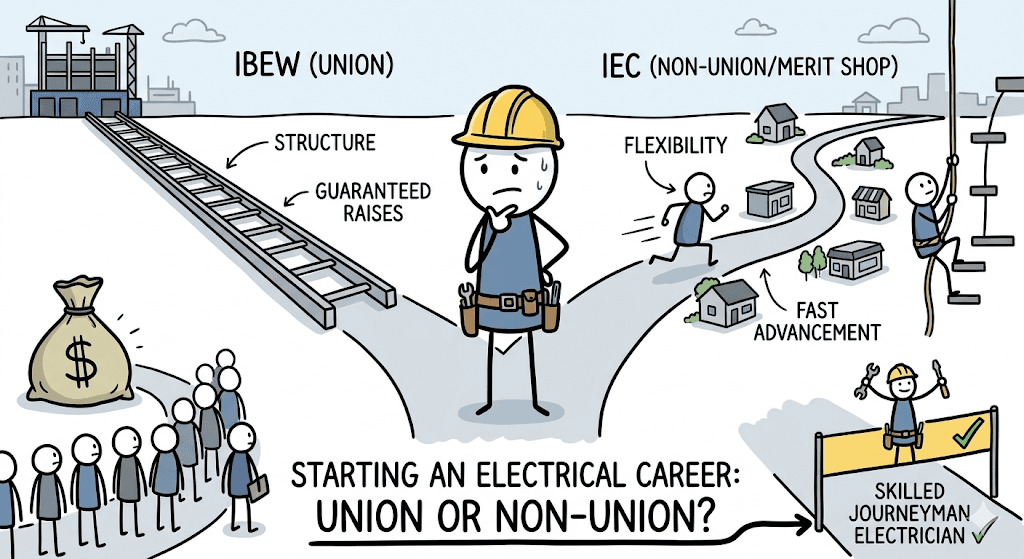
Entering the electrical trade is one of the smartest career moves you can make today. With an aging workforce retiring and a massive push for updated infrastructure, the demand for skilled electricians is incredible. But before you strap on your tool belt and start pulling wire, you have a major decision to make. Do you go the union route with the International Brotherhood of Electrical Workers (IBEW) or choose the non-union, merit-shop path with the Independent Electrical Contractors (IEC)?
At SpliceJobs, we see hundreds of aspiring electricians asking this exact question. The truth is that there is no single correct answer. Both programs turn green helpers into highly skilled journeyman electricians. Both programs teach you how to work safely with high voltage and respect the building codes. However, the day-to-day experience, pay structures, and long-term career trajectories look very different.
Let us break down exactly what you can expect from each route so you can make the best choice for your future.
Understanding the Union Path with the IBEW and NECA
When people talk about going union, they are talking about the partnership between the IBEW and the National Electrical Contractors Association. Together, these organizations run the Joint Apprenticeship and Training Committee (JATC). This program is widely considered the gold standard of electrical training across North America.
The curriculum is developed by the Electrical Training Alliance, meaning you get a standardized, rigorous education regardless of your state.
What to Expect as a Union Apprentice
Highly Structured Training: You will log roughly 8,000 hours of on-the-job training and up to 1,000 hours in the classroom over four to five years.
Guaranteed Wage Progressions: Your pay is laid out in a collective bargaining agreement. As you complete your required classroom hours and job site hours, your hourly rate increases automatically. You never have to ask the contractor for a raise.
Top-Tier Benefits: Union apprentices typically receive excellent health insurance and pension contributions. These benefits are completely separate from your hourly take-home pay.
Large-Scale Commercial Work: Union contractors often secure bids on massive commercial and industrial jobs. You might spend months installing heavy-duty cable tray, pulling large feeder wires, and learning complex circuitry on a hospital, data center, or factory build.
The main challenge of the IBEW path is the entry process. It is highly competitive. You must pass an aptitude test covering basic algebra and reading comprehension, followed by a formal interview with the committee. Depending on your local chapter, it can take months or even a year to get accepted.
Exploring the Merit Shop Route with the IEC
If you prefer a free-market approach to your career, the Independent Electrical Contractors offers a fantastic alternative. The IEC represents non-union electrical contractors. In a merit shop environment, your career advancement is based directly on your individual performance, work ethic, and technical skills.
What to Expect as an IEC Apprentice
Faster Entry into the Trade: Getting started is usually much quicker. You typically find an IEC member contractor, get hired as a helper, and then enroll in the local IEC training program. You can start getting your hands dirty, organizing the work van, and earning a paycheck almost immediately.
Merit-Based Pay: Instead of a strict wage scale, your employer determines your pay. If you hustle, learn to read blueprints quickly, and master your hand tools, you can negotiate raises on your own terms.
Diverse Job Sites: Merit shop contractors often handle a wide mix of residential, light commercial, and service calls. You might rough-in a custom home with Romex one week and bend EMT conduit for a retail store the next. This variety builds a very well-rounded, adaptable skill set.
Certified Curriculum: The IEC uses a curriculum that is typically approved by the US Department of Labor Apprenticeship program, ensuring you get the recognized hours and education required to sit for your state or local journeyman exam.
The trade-off with the merit shop route is that benefits vary from contractor to contractor. Some larger non-union companies offer great 401k matches and health plans, while smaller local outfits might offer less robust packages.
Shared Ground: Code, Safety, and Licensing
Whether you go union or merit shop, the core mechanics of the trade remain exactly the same. Electricity does not care if you carry a union card.
Both programs will drill the National Electrical Code (NEC )into your head. You will learn Ohm's Law, how to calculate voltage drop, and how to size conductors properly to prevent fires. You will learn how to use digital multimeters, wire strippers, and lineman pliers with precision.
Safety is heavily emphasized across the board. You will receive extensive training on OSHA construction standards, proper use of Personal Protective Equipment, and critical lockout and tagout procedures. The Bureau of Labor Statistics notes that electricians face high rates of on-the-job injuries, so both the IBEW and IEC take hazard awareness incredibly seriously.
For veterans looking to enter the trade, both organizations frequently partner with transition groups like Helmets to Hard Hats to turn military discipline into a civilian career. Additionally, many training centers align their hands-on assessments with standards set by the National Center for Construction Education and Research, providing credentials that employers respect nationwide.
How to Make Your Final Choice
So, how do you actually decide which path to take? Here are a few practical tips.
Assess Your Immediate Financial Needs Can you afford to wait six months on a union waiting list? If you need a steady paycheck next week, finding an open spot with an IEC contractor might be your smartest move. Many electricians start non-union to gain valuable basic experience while they wait for their JATC interview to get scheduled.
Check the Strength of Your Local Market The dominance of unions varies heavily by region. In many northern and midwestern cities, the IBEW controls the vast majority of commercial work. In many southern states, merit shops and IEC contractors handle most of the heavy lifting. Research the job market in your specific area to see who is doing the type of work you want to do.
Consider Your Long-Term Career Goals Do you want the security of a guaranteed pension and the massive support network of a brotherhood? The IBEW is hard to beat for long-term stability. On the other hand, do you dream of opening your own electrical contracting business one day? The business-focused environment of an IEC contractor might give you a closer look at how owners bid jobs, manage overhead, and run a crew.
Both the IBEW and the IEC produce top-tier, highly capable electricians. The real difference comes down to your timeline, your personal values, and the specific opportunities right in your backyard. Whichever path you choose, commit to it fully. Show up early, work hard, and absorb every piece of knowledge your journeyman shares.
To find the latest apprenticeship openings and connect with top electrical employers, keep your job search active right here on SpliceJobs.