How Hard Is It to Become an Electrician? What to Really Expect

SpliceJobs Team
Published on 5/17/2026
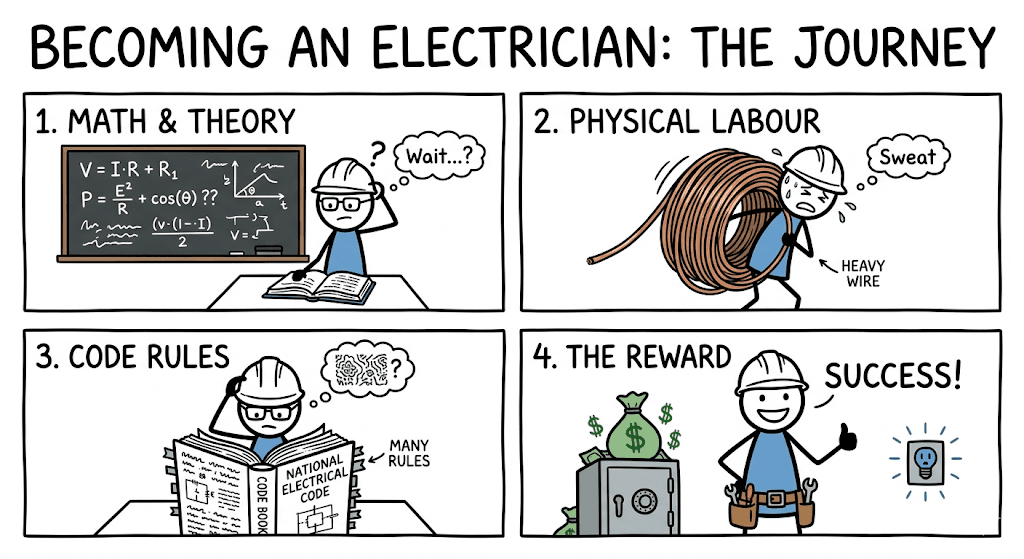
If you are looking at the trades, becoming an electrician is probably at the top of your list. It is a career that offers great pay, strong job security, and the respect of everyone else on the jobsite. But you have likely heard rumors about how tough it is to break into the field. Some people say the math is brutal. Others tell you the physical toll will burn you out by thirty.
So, how hard is it to become an electrician?
The honest answer is that it is challenging, but not for the reasons most people think. It does not require a genius level IQ or the muscles of a bodybuilder. It requires patience, a solid work ethic, and a willingness to learn a highly technical craft.
Here is a realistic breakdown of what it takes to make it in the electrical trade across North America.
The Reality of Electrical Math and Classroom Work
One of the biggest fears for high school graduates and career changers is the classroom portion of the training. Many people worry they cannot handle the math.
The truth is that you do not need advanced calculus to succeed. You do need a firm grip on basic algebra, fractions, and basic geometry. You will use these math skills to calculate load sizes, figure out voltage drops, and bend conduit accurately.
During your schooling, you will spend a lot of time studying theory and rules. You will learn about how circuitry works, how electrical currents behave, and how to navigate massive reference books.
The Code Book: In the United States, you will study the National Electrical Code. In Canada, you will study the Canadian Electrical Code. These books are thick, detailed, and full of strict regulations. You do not have to memorize every page, but you must learn how to look up rules quickly to ensure your work is legal and safe.
The Exams: To advance from an apprentice to a journeyman, you must pass state or provincial licensing exams. These tests are timed and notoriously tricky, which is why paying attention during your technical training is non-negotiable.
Physical Demands on the Jobsite
Do not let the technical side fool you. This is still a construction trade. You will not just be sitting around looking at blue prints all day. The physical work is steady and can be exhausting when you first start out.
Daily Physical Challenges
Working in Tight Spaces: You will regularly crawl into dark attics, squeeze into tight crawlspaces, and work inside cramped mechanical rooms.
Heights and Ladders: Electricians spend a massive amount of time on extension ladders, scissor lifts, and scaffolding running wire or mounting fixtures.
Handling Material: Pulling heavy copper wire through hundreds of feet of conduit takes serious upper body strength. You will also spend hours handling heavy tools, loading boxes of materials, and operating hydraulic benders.
The good news is that your body adapts. Within a few months on the job, your grip strength will improve, and your stamina will build up.
Managing the Safety Risks
Working with electricity carries real dangers. A single mistake can cause severe shocks, arc flashes, or fires. Because of this, the trade demands total focus. If you are someone who gets distracted easily or likes to cut corners, this is not the career for you.
You will have to learn and strictly follow safety protocols set by organizations like the Occupational Safety and Health Administration (OSHA)in the US or the Canadian Centre for Occupational Health and Safety (CCOHS) in Canada. Learning how to properly lock out and tag out electrical panels before touching wires will become second nature. Safety is the hardest part of the job because you can never afford to have a bad day or lose focus.
The Long Journey of an Apprenticeship
Becoming a fully qualified journeyman electrician is a marathon, not a sprint. The standard training path across North America is an apprenticeship that takes four to five years to complete.
Requirement Type | Average Expectation |
On-the-Job Training Hours | 8,000 hours |
Classroom Instruction Hours | 600 to 900 hours |
Total Time Investment | 4 to 5 years |
Finding an apprenticeship can sometimes be the hardest part of the process. You can apply directly through local union chapters like the International Brotherhood of Electrical Workers (IBEW) and their training arms, such as the Electrical Training Alliance.
Alternatively, you can apply directly to open shops and non-union contractors through organizations like the National Electrical Contractors Association (NECA). If you want to get a head start before applying, looking into trade schools or checking financial assistance options via Federal Student Aid can help you cover pre-apprenticeship program costs.
The upside to this long timeline is that you get paid for your work from day one. You earn while you learn, and your hourly wage increases every single year as you hit your hour milestones.
Is the Difficulty Worth the Payoff?
While the path is long and demands hard work, the rewards match the effort. The job market for skilled tradespeople remains incredibly strong. According to data from the US Bureau of Labor Statistics (BLS), the demand for electricians is projected to grow steadily over the next decade. Similar strong growth trends can be seen on the Government of Canada Job Bank, driven by home renovations, commercial builds, and the shift toward renewable energy.
Once you have your license, you unlock a steady career with excellent earning potential. You can choose to specialize in industrial automation, work on large commercial projects, or stick to residential service calls. Many experienced electricians eventually take the step to become independent contractors and run their own businesses.
To maintain your edge and stay safe throughout your career, you will also interact with organizations like the National Fire Protection Association (NFPA) to keep up with code updates, and the Electrical Safety Foundation International (ESFI) for ongoing safety awareness.
How to Get Started
If you are ready to take on the challenge, start by making sure your high school math credits are in order. Reach out to local contractors, look up union locals in your area, and start applying for helper or apprentice positions.
The road to becoming a licensed electrician has plenty of hurdles, but every single one of them can be cleared with focus and persistence. When you are ready to see what opportunities are available out there, check out the latest job openings on SpliceJobs to kickstart your career in the electrical trade.