What Does an Electrician Apprentice Do? Daily Duties Unplugged

SpliceJobs Team
Published on 4/6/2026
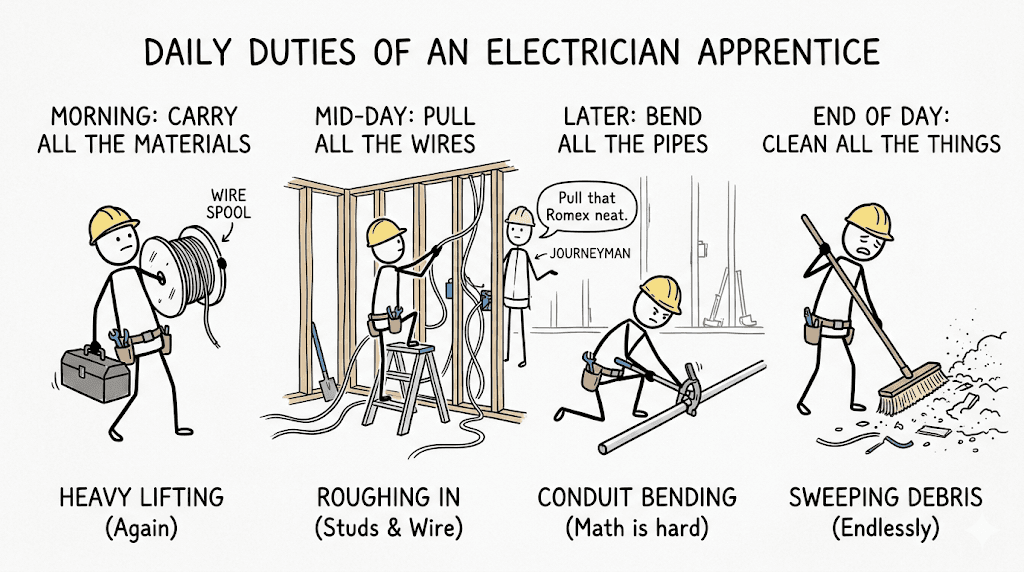
If someone asks what an electrical apprentice actually does all day, and half the replies joke about finding the imaginary "wire stretcher" or simply sweeping the site until the bristles wear out. But jokes aside, the apprenticeship is the undisputed backbone of the electrical trade.
It is a mix of grueling physical labor, intense mental math, and a remarkably steep learning curve. As a senior trades writer here at SpliceJobs, I have spoken with countless journeymen, master electricians, and first-year helpers. Here is the unvarnished, fluff-free look at your actual daily duties.
Kicking Off the Day with Logistics and Layout
The day starts early, and you are usually the first one out of the truck. Before anyone touches a pair of linesman pliers or strips a single wire, the job site needs preparation. Your absolute first duty is material management.
This is not just moving boxes. You are actively learning the names of hundreds of highly specific parts. A half inch EMT connector looks entirely different from a rigid connector, and mixing them up wastes the contractor's money. Daily morning duties generally include the following tasks:
Unloading heavy conduit bundles and massive wire spools from the company truck.
Organizing the gang box to ensure power tools and hand tools are easily accessible.
Sweeping the immediate work area to prevent dangerous trip hazards.
Reviewing the daily blueprint goals alongside your supervising journeyman.
According to the National Center for Construction Education and Research (NCCER), precise material identification is a foundational competency taught in the very first months of any credible training program.
The Physical Reality of Wire Pulling and Conduit Bending
Once the site is properly prepped, the real physical labor begins. In residential settings across sprawling Texas subdivisions, your daily duty might involve drilling through wooden studs and pulling Romex through uncomfortably hot attics. In a commercial high rise in downtown Chicago, you will be wrestling with heavy MC cable or pulling THHN wire through miles of metal piping.
Conduit bending is where the art of the trade meets the science. Apprentices spend hours mastering the hand bender. You will learn how to calculate offsets, three-point saddles, and precise ninety degree bends. It is never just brute force. It requires trigonometry and fractions. You must understand bend deductions to make the pipe fit perfectly tight against the wall. The National Electrical Contractors Association (NECA) frequently emphasizes that precision in conduit bending reduces material waste and drastically improves the visual aesthetic of exposed electrical work.
Strict Adherence to the Codebook
You are never just pulling wire blindly. Every single action you take is governed by incredibly strict safety rules. The National Fire Protection Association (NFPA) publishes the National Electrical Code, commonly known on the job site as the NEC.
As an apprentice, your daily duty involves applying these codes under close supervision. Your journeyman will constantly quiz you. How many wires are legally allowed in this specific junction box? What is the required burial depth for this outdoor PVC conduit? Memorizing these codes is non-negotiable for passing your eventual state licensing exams.
Mastering the Tool Pouch and Site Safety Protocols
Your tool pouch is your livelihood. Knowing exactly what to put in it on day one separates the prepared apprentices from the liabilities. Before you spend a fortune on unnecessary gear, read our complete guide to the essential tools for first-year electrician apprentices.
Electrical work is inherently dangerous. Therefore, strict adherence to the safety guidelines set by the Occupational Safety and Health Administration (OSHA) is a mandatory daily duty. You will learn the critical process of Lockout/Tagout. This vital protocol ensures that a circuit is completely de-energized and locked down before anyone touches the copper. Additionally, since you will spend half your working life climbing, you must follow National Institute for Occupational Safety and Health (NIOSH) ladder safety guidelines. A simple slip from the top rung can end a promising career before it truly starts.
Basic Troubleshooting and Diagnostic Introduction
As you progress past the initial months of fetching materials, your journeyman will introduce you to the intricate art of troubleshooting. You will certainly not be tasked with diagnosing a complex motor control center on day one. However, your daily duties will expand to testing basic continuity.
You will assist in tracing dead circuits through sprawling commercial complexes. Learning to read the subtle signs of a failing electrical system takes years. You will start by watching how the senior electricians systematically isolate electrical variables.
The Unseen Duty of Classroom Education
The daily duties actually do not end when you clock out of the job site. The electrical trade operates on a rigorous dual learning model. After a grueling physical shift, you will frequently head straight to a classroom. Programs coordinated by the Electrical Training Alliance (ETA) or local union halls dictate your heavy curriculum.
You will study alternating current theory, advanced blueprint reading, and motor controls. The International Brotherhood of Electrical Workers (IBEW) requires hundreds of intensive classroom hours to directly complement your thousands of on the job training hours. It is undeniably exhausting, but it builds a comprehensive understanding of the physics behind the daily physical work.
The Clear Path Forward to Journeyman Status
Why endure the heavy lifting, the complex mathematical formulas, and the incredibly long days? Because the payoff at the finish line is substantial. The Bureau of Labor Statistics (BLS) tracks the steady job growth and the high earning potential of fully licensed electricians.
Completing your daily duties with accuracy and pride slowly transforms you from a green helper into a highly skilled craftsman. The federal government deeply recognizes the value of this specific career path, offering vast resources through Apprenticeship.gov to help dedicated workers secure these highly coveted roles.
Every spool of wire you carry and every single code rule you memorize is an investment in your future. Welcome to the trade, SpliceJobs members. Stay safe out there, always measure twice, and keep studying that codebook.