How to Land an Electrician Job Without a Degree

SpliceJobs Team
Published on 4/14/2026
How to Land an Electrician Job Without a Degree
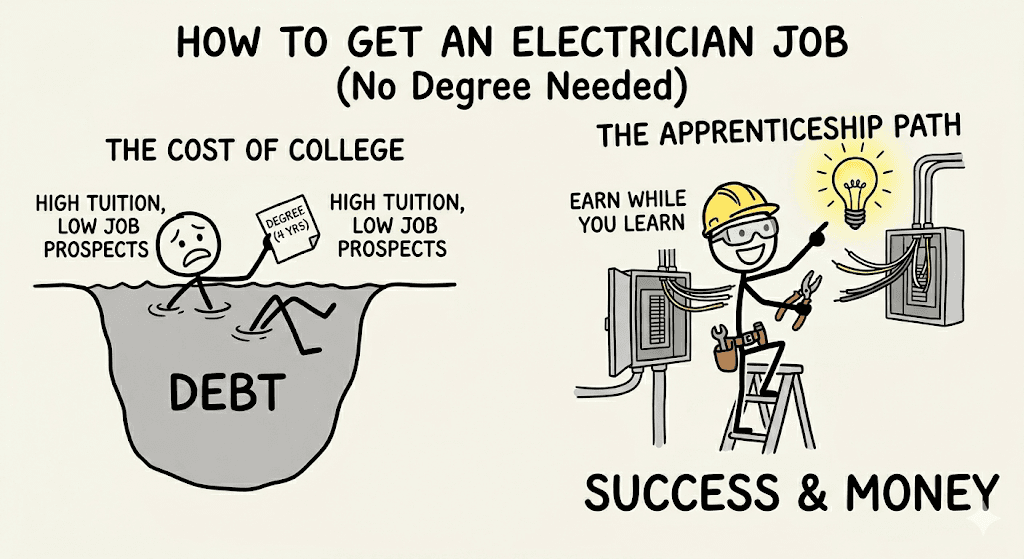
You do not need a traditional four-year university diploma to build a highly lucrative and respected career in the electrical trade. In fact, while university graduates are often saddled with massive student loan debt, entering the electrical field allows you to earn a paycheck while you learn the ropes. Welcome to SpliceJobs, where we strip away the fluff and give you the grounded truth about building a career with your own two hands.
If you are looking at the booming construction skylines in places like Texas, California, or Florida, you are looking at thousands of unfilled, high-paying jobs. According to the Bureau of Labor Statistics, the demand for qualified electricians is projected to grow substantially over the next decade. The path to securing one of these roles involves grit, a willingness to learn, and following a specific roadmap.
The Reality of the Trades and the Apprenticeship Advantage
The electrical industry operates on a master and apprentice model. Contractors and master electricians do not care if you can write a thesis on 18th-century literature. They care if you can understand basic algebra, show up exactly on time, and follow strict safety protocols when dealing with live circuitry.
Your golden ticket into this world is an apprenticeship. This is a structured program where you work full-time under the supervision of a licensed journeyman while attending classroom instruction.
Choosing Your Path: Union vs. Non-Union Route
When you start your journey, you generally have two main avenues to secure an apprenticeship.
The Union Path: Joining an organization like the International Brotherhood of Electrical Workers (IBEW) offers fantastic benefits, a clear pay scale, and incredible training facilities. The competition can be tough, and the application process requires passing an aptitude test focused on algebra and reading comprehension.
The Non-Union Path: Also known as the merit shop route. You can apply directly to local electrical contractors or join programs managed by non-union trade associations. You can find many of these certified programs listed on the federal Apprenticeship.gov database.
Ground Zero: Preparing for Your First Day on the Jobsite
If you have absolutely no experience, jumping straight into a competitive apprenticeship can feel daunting. There are alternative stepping stones to get your boots on the ground.
Utilizing Pre-Apprenticeship Programs
Pre-apprenticeship programs are designed to give you the basic math, safety, and tool skills required to be an attractive candidate for contractors. Government-funded programs like Job Corps offer free vocational training for young adults. These programs teach you how to strip wire, understand basic circuit pathways, and safely navigate a busy construction site.
Additionally, industry-recognized credentialing bodies like the National Center for Construction Education and Research (NCCER)offer core curriculum courses. Completing an NCCER module shows prospective employers that you are entirely serious about the trade.
Essential Tools and Non-Negotiable Soft Skills
A formal degree might not be required, but a specific mindset absolutely is. Being a first-year apprentice is physically and mentally demanding. You will spend a lot of time digging trenches, pulling heavy Romex cable, and fetching materials.
What Belongs in Your Starter Toolbelt
Do not show up to your first day empty-handed. While contractors provide major power tools, you are expected to bring your own hand tools.
High-quality linesman pliers
A reliable set of wire strippers
Phillips and flathead screwdrivers (insulated preferred)
A non-contact voltage tester
A sturdy tape measure
Beyond the physical tools, your soft skills will dictate how fast you rise in the ranks. Master electricians want apprentices who ask smart questions, stay off their cell phones, and hustle. Understanding basic Ohm's law and basic fractions will put you miles ahead of the competition.
Safety Certifications and Navigating Red Tape
Electricity is inherently dangerous. Therefore, safety is not just a buzzword; it is the absolute foundation of the trade. Before you even apply for jobs on SpliceJobs, you should look into securing basic safety certifications.
The Power of an OSHA Certification
Employers want to know you will not be a liability. Earning an OSHA 10-Hour Construction certificate proves you understand workplace hazards. You can find authorized training providers directly through the Occupational Safety and Health Administration website. Knowing how to properly use Personal Protective Equipment (PPE) and understanding lockout/tagout procedures are non-negotiable skills.
Furthermore, familiarizing yourself with the National Electrical Code (NEC) published by the NFPA will give you a massive advantage. You do not need to memorize the entire book, but knowing how to navigate it to find rules on conduit fill or grounding requirements shows immense initiative.
Localizing Your Career Strategy
Demand and licensing regulations vary wildly depending on your location. New York and Chicago have heavy commercial and industrial demands with strict union presence. Meanwhile, sprawling suburban growth in Texas creates endless opportunities for residential wiremen.
Every single state handles electrical licensing differently. Some states issue journeyman licenses at the state level, while others handle it at the county or city level. Always research your specific state licensing board. Organizations like the National Electrical Contractors Association (NECA) often provide resources on regional contractor demands and local code adoption. Safety protocols can also vary by climate and industrial sector, so checking resources from the National Institute for Occupational Safety and Health (NIOSH) is a smart move for long-term health in the trade.
Building Your Network and Securing the Bag
You have the basic knowledge, you have your hand tools, and you have a solid work ethic. Now it is time to connect with the right people.
Use the SpliceJobs platform to find local contractors actively looking for green apprentices. Tailor your resume to highlight any mechanical experience, math skills, or physical labor background you possess. If you worked in a warehouse, highlight your reliability and stamina. If you fixed cars in your driveway, highlight your mechanical aptitude.
Finally, consider getting involved with groups that champion the trades, such as SkillsUSA, which hosts events and networking opportunities for technical education students.
Landing an electrician job without a college degree is entirely achievable. It requires swapping the lecture hall for the jobsite and replacing a textbook with a toolbelt. Stay safe, stay eager to learn, and let SpliceJobs help you find that crucial first opportunity.