How to Become an Electrician in Texas

SpliceJobs Team
Published on 6/11/2026
Texas is building at a record pace. From the sprawling subdivisions expanding the edges of Houston to the massive tech campuses popping up all over Austin, the construction boom is undeniable. Every single one of those new homes, factories, and office buildings requires power. That means Texas contractors are desperate for skilled electricians.
If you just finished high school and want a career that pays exceptionally well without burying you in college debt, the electrical trade is a smart choice. You get to work with your hands, solve real problems, and earn a paycheck while you learn the ropes. But you cannot just walk onto a job site and start wiring a breaker panel. You have to follow the rules, learn the safety protocols, and put in the sweat equity.
Here is the exact path to getting your license, building your skills, and finding top opportunities through SpliceJobs.
The Big Boss: Understanding the TDLR
In the state of Texas, everything related to electrical work runs through the Texas Department of Licensing and Regulation. We just call it the TDLR. They issue the licenses, set the rules, and enforce the standards.
You cannot legally perform electrical work for a contractor in Texas without a license from the TDLR. The state uses a tiered system to track your progress and skill level. You will start at the bottom and work your way up. The main license levels are Apprentice, Journeyman, and Master Electrician. Your first major career goal is to hit that Journeyman level.
Step 1: Secure Your Apprentice License
Your very first step is to get your Electrical Apprentice license. The good news is that this part is incredibly simple. You do not need any prior experience to get this piece of paper.
To qualify, you simply need to be at least 16 years old. You go to the TDLR website, fill out the application, pay a small fee, and pass a basic background check. Once that license arrives, you are legally allowed to assist a licensed Journeyman or Master Electrician on a job site. Keep your license in your wallet at all times. State inspectors do visit job sites, and if they catch you working without it, you and your boss will face strict fines.
Step 2: Find a Contractor or Apprenticeship Program
Having an apprentice license does not automatically give you the skills to wire a house. You need someone to teach you. You have two main routes to get your training in Texas.
The Non-Union Route
Many apprentices simply apply directly to non-union electrical contractors. You can find hundreds of entry-level listings on SpliceJobs. In this setup, you learn directly on the job. Many non-union contractors also partner with organizations like the Independent Electrical Contractors (IEC) or Associated Builders and Contractors (ABC). These groups provide the classroom hours you need in the evenings while you work during the day.
The Union Route
Your other option is to join the International Brotherhood of Electrical Workers (IBEW). You apply through your local Joint Apprenticeship and Training Committee (JATC). Texas has several strong locals in major cities like Dallas, San Antonio, and Houston. Union programs are highly structured. They guarantee your pay scale, schedule your classes, and place you with affiliated contractors. Competition to get into a union apprenticeship can be tough, so you will need to pass a basic math and reading aptitude test.
Step 3: Put in the Hours on the Job
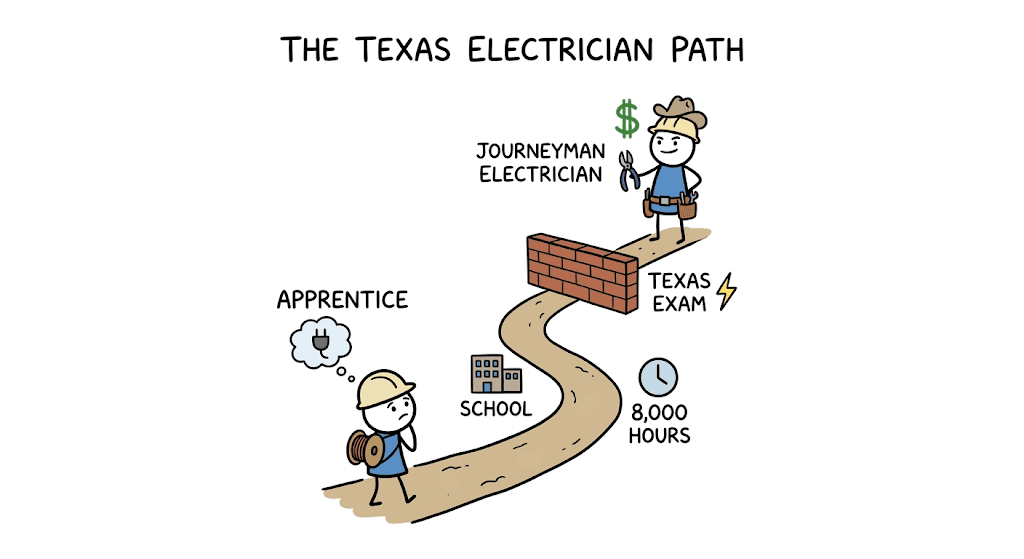
To become a Journeyman in Texas, the TDLR requires you to complete 8,000 hours of on-the-job training. That breaks down to roughly four years of full-time work.
Do not expect to be doing complex circuitry on day one. Your first year will be hard, physical labor. You will spend time digging trenches for underground conduits, organizing the material truck, and hauling heavy spools of wire up flights of stairs. You will also learn the absolute basics of safety, including strict lockout and tagout procedures to ensure nobody gets shocked.
As you log more hours, your responsibilities will grow. By your second and third years, you will be pulling wire, bending conduit pipe, terminating outlets, and understanding how power flows from the main utility line all the way to a light switch. You will learn the difference between wiring a residential home with flexible non-metallic cable and running commercial power through rigid metal pipes.
Step 4: Master the Classroom Instruction
While you are sweating on the job site, you also need to hit the books. Texas requires apprentices to log classroom hours before they can sit for the state exam.
The electrical trade is highly technical. You need to understand Ohm's Law, calculate voltage drop across long distances, and figure out the correct load calculations for a massive breaker panel. Most importantly, you will study the National Electrical Code. The NEC is the massive rulebook that dictates exactly how every single wire must be installed to prevent fires and ensure public safety. It is a thick, complicated book, and you need to know how to navigate it quickly.
Step 5: Pass the Texas Journeyman Exam
Once you hit your 8,000 on-the-job hours and finish your required schooling, the TDLR will let you take the Journeyman Electrician exam.
This test is not a walk in the park. It is a timed, open-book exam based entirely on the NEC and basic electrical theory. You will be tested on safety protocols, motor calculations, and wire sizing. Once you pass this test, you officially earn your Journeyman license. This is a massive milestone. It means you can work independently, supervise apprentices, and demand a much higher salary.
The Texas Job Market and Salary Expectations
The demand for electrical workers is massive across the entire state. If you are willing to work hard and show up on time, you will never go hungry in this trade.
Hot Spots: The Dallas-Fort Worth metroplex and the greater Houston area are currently exploding with commercial and industrial projects. Austin is seeing massive residential growth alongside heavy tech manufacturing plants.
Apprentice Pay: Starting out, a green apprentice in Texas usually makes between $16 and $20 per hour. It is entry-level pay, but remember that you are getting paid to learn instead of paying a college tuition.
Journeyman Pay: Once you get your Journeyman license, your pay jumps significantly. Depending on the city and whether you work residential or commercial, Journeymen in Texas pull in between $30 and $45 per hour. Experienced electricians working industrial jobs or running large commercial crews can make well over $90,000 a year.
Essential Tools for Day One
If you land your first job through SpliceJobs, you need to show up prepared. Contractors will provide the big power tools and materials, but you are expected to bring your own basic hand tools. Buy quality gear. Cheap tools will break and slow you down.
Here is what you need in your toolbelt on your first morning:
A solid pair of lineman pliers for cutting and twisting thick wire.
Quality wire strippers.
A set of insulated screwdrivers (both flathead and Phillips).
A durable tape measure.
A non-contact voltage tester to keep yourself alive.
A sharp utility knife.
Steel-toe or composite-toe work boots. The job sites are dangerous, and you need to protect your feet.
Becoming an electrician in Texas takes time, thick skin, and a willingness to learn. It is hard work, especially in the brutal summer heat. But the payoff is a respected, high-paying career that no machine can replace. Get your TDLR apprentice license, grab your tools, and check out SpliceJobs to find the contractor who will help launch your career.