How Long Does It Take to Become an Electrician? The Real World Timeline

SpliceJobs Team
Published on 5/28/2026
If you are looking for a career that keeps you on your feet, challenges your brain, and pays exceptionally well without massive student debt, stepping into the electrical trade is a smart move. But before you start buying wire strippers and multimeters, you need to know the reality of the training timeline. At SpliceJobs, we get this question constantly from high school graduates and career changers alike. Exactly how long does it take to become an electrician?
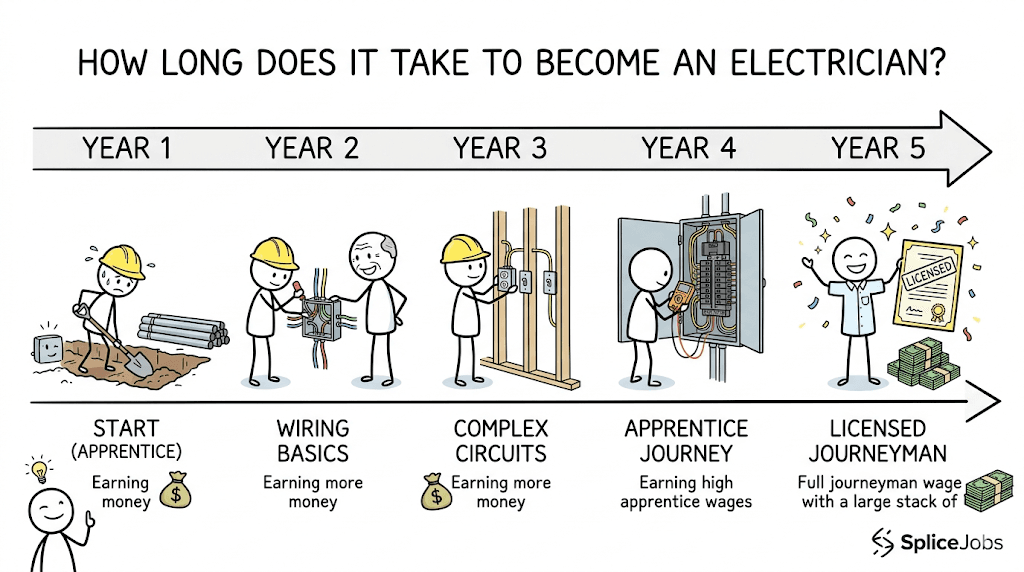
The short answer is that becoming a fully licensed journeyman electrician takes roughly four to five years. However, unlike a traditional four year college degree where you pay to sit in a classroom, electrical apprentices get paid while they learn the trade on actual job sites.
Let us break down the exact timeline, the training hours required, and the different paths you can take to get your license across North America.
The Foundation of Your Electrical Career
You do not just walk onto a job site and start wiring up 200-amp service panels. Electricity is dangerous, and learning to respect it takes guided, hands-on experience. The industry standard path to becoming an electrician is through an apprenticeship.
Decoding the Apprenticeship Hours
A standard electrical apprenticeship requires a massive commitment to both fieldwork and technical study. Most programs mandate between 8,000 and 10,000 hours of documented training.
Here is what that looks like in the real world:
On the Job Training: You will spend 8,000 hours working under the direct supervision of a licensed journeyman or master electrician. This translates to roughly four years of working 40 hours a week.
Classroom Instruction: You will also need between 500 and 1,000 hours of classroom time. This is where you learn electrical theory, circuitry, blueprint reading, and safety protocols.
During your first year, you will likely be digging trenches, fetching materials, and learning the absolute basics of handling tools. By year three, you will be pulling wire, troubleshooting complex circuitry, and understanding the deep details of safety codes.
For the most accurate projections on job growth and training expectations in the United States, you can check the Bureau of Labor Statistics. If you need help finding a registered program, Apprenticeship. gov is an excellent starting point.
Choosing Your Path to Certification
There is more than one way to wire a house, and there is more than one way to get your electrical ticket. The route you choose will dictate your exact timeline and training environment.
The Union Apprenticeship Route
Many tradespeople choose the union path through the International Brotherhood of Electrical Workers (IBEW). These apprenticeships are highly competitive and structured. IBEW programs typically take a full five years to complete because they mandate closer to 10,000 total hours. The trade-off for that extra year is a rigorous, world class education and strong union benefits once you turn out as a journeyman.
Independent Contractor Programs
If the union route does not fit your location or goals, the non-union or "open shop" path is equally valid. Organizations like the Independent Electrical Contractors (IEC) run phenomenal apprenticeship programs. These often follow the four year, 8,000 hour model. Open shop apprenticeships can sometimes offer more flexibility in scheduling and allow you to work closely with smaller, residential or commercial contractors.
Trade Schools and Accelerated Options
Can you speed up the process? Yes and no. Going to a technical college or trade school before seeking an apprenticeship can give you a massive advantage. Programs using the National Center for Construction Education & Research (NCCER)curriculum will teach you the fundamentals of AC/DC theory, conduit bending, and basic wiring before you ever step foot on a job site.
Alternatively, government funded programs like Job Corps offer free electrical training for eligible young adults. Completing a pre-apprenticeship or trade school program takes anywhere from six months to two years. While this does not completely replace your on the job training requirements, many states and apprenticeship boards will credit your classroom time toward your final 8,000 hours.
Safety and Code Mastery
You cannot talk about becoming an electrician without talking about code and safety. Your timeline to becoming a journeyman includes mastering these crucial aspects of the trade.
Learning the Rulebook
Whether you are working in a residential basement or a massive commercial high rise, all electrical work must comply with strict safety standards. In the United States, your training will revolve heavily around the National Electrical Code (NFPA 70). Reading and interpreting this massive document is a skill that takes years to refine.
Staying Alive on the Job
Electricity does not offer second chances. Part of your apprenticeship timeline involves earning mandatory safety certifications. You will almost certainly be required to complete OSHA Outreach Training, usually the OSHA 10 or OSHA 30 certification. This training ensures you understand workplace hazards, lockout/tagout procedures, and proper personal protective equipment.
Industry groups like the National Electrical Contractors Association (NECA) also provide extensive resources on safety standards and best practices that you will study throughout your career.
Regional Differences Across North America
The specific requirements to sit for your journeyman exam vary wildly depending on where you live.
United States Local Rules: Some states require 8,000 hours, while others might ask for 12,000 hours before you can test for your license. Certain states also require you to hold a specific apprentice license from day one.
The Canadian Standard: In Canada, the ultimate goal is achieving your Red Seal. The Red Seal Programensures that your skills are recognized across different provinces. A Canadian electrical apprenticeship generally takes four to five years, consisting of 9,000 hours of on the job training split into four separate training periods.
Life After the Apprenticeship
The learning does not stop when you get your journeyman card. After working independently for another two to four years, many electricians choose to test for their Master Electrician license. Becoming a master electrician requires thousands of additional hours of supervisory experience and a deep understanding of business law, electrical design, and advanced code application.
Becoming an electrician is not a quick process. It is a serious investment of time, sweat, and brainpower. But if you are willing to put in the four to five years required to learn the trade correctly, you will secure a high paying, recession proof career for the rest of your life. Keep your head down, ask questions, and respect the power you are working with.