How to Become an Electrician in Michigan

SpliceJobs Team
Published on 6/6/2026
Getting your start in the electrical trade is one of the smartest career moves you can make today. If you live in Michigan, the demand for skilled tradesmen is booming. From the massive auto plants retrofitting for electric vehicles to new residential builds in Grand Rapids, contractors are constantly hunting for people who know how to pull wire and read a blueprint.
Whether you just finished high school or you want to switch careers, becoming an electrician gives you a clear path to high pay and job security. Here is exactly how you can earn your license and build a solid career in the Great Lakes State.
Why Wiring in Michigan is a Smart Career Move
Michigan has a deep history of manufacturing and building. Right now, there is a massive push to update old infrastructure and build modern, energy-efficient facilities. Older electricians are retiring by the thousands every year. This leaves a massive gap in the workforce. Employers need fresh talent who are willing to learn safety protocols, master circuitry, and work hard.
When you choose this path, you are not just taking a job. You are learning a specialized craft. You will understand how electricity flows, how to safely handle live panels, and how to keep buildings up to code. It takes time and sweat, but the payoff is a career that cannot be outsourced.
The Core Steps to Earning Your Michigan Electrical License
The state of Michigan takes electrical safety very seriously. You cannot simply buy a tool belt and call yourself an electrician. The Michigan Department of Licensing and Regulatory Affairs (LARA) regulates the trade. They require strict on-the-job training and classroom hours.
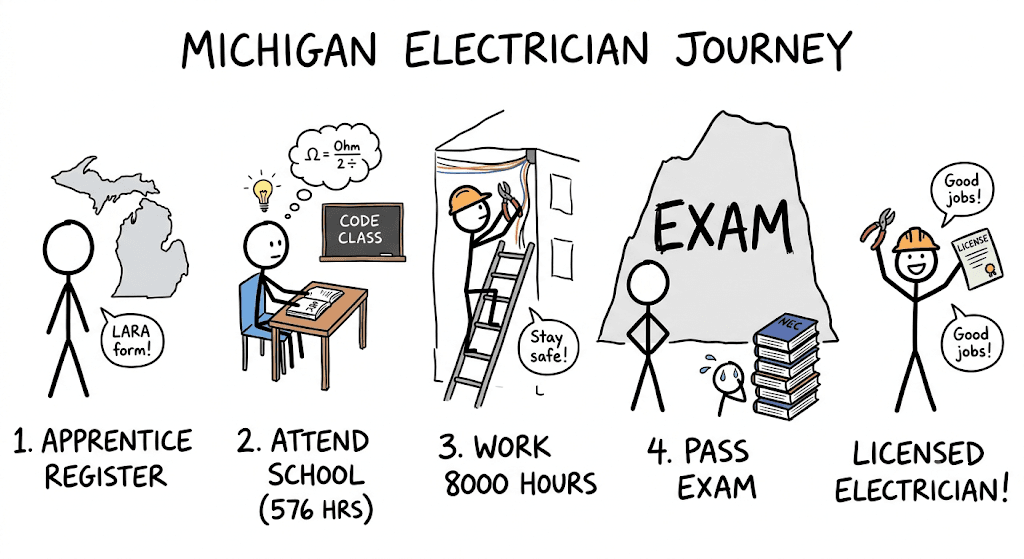
Step 1: Register as an Electrical Apprentice
Every journeyman starts out as an apprentice. Your very first step is to get hired by a licensed electrical contractor and register with the state. Within 30 days of getting a job, you must fill out an apprentice registration form with LARA.
As an apprentice, your job is to learn. You will start with the basics. Expect to spend a lot of time organizing materials, bending rigid conduit, pulling heavy wire, and learning the names of every tool on the truck. You will work under the direct supervision of a licensed journeyman or master electrician. They will teach you how to strip wires cleanly, read panel schedules, and follow the National Electrical Code (NEC).
To qualify for your journeyman exam later, you must log exactly 8,000 hours of practical work experience. Working full time, this takes about four years.
Step 2: Complete Your Classroom Instruction
You cannot learn everything just by turning a screwdriver. Michigan requires apprentices to complete related technical instruction. You need to understand the math behind the trade. You will learn Ohm's law, voltage drop calculations, and how to balance electrical loads.
Most apprentices complete at least 576 hours of classroom time over their four-year apprenticeship. You can get this schooling through a union training center or a local community college.
Step 3: Pass the Journeyman Electrician Exam
Once you have your 8,000 work hours and your classroom certificates, you can apply to LARA to take the state journeyman exam. This test is known for being tough. You must prove you understand the current NEC code book and Michigan-specific building laws.
The test covers everything from grounding and bonding to motor controls and general wiring methods. When you pass this exam, you officially earn your journeyman license. This means you can work without direct supervision, and it usually comes with a major pay raise.
Choosing Your Training Route: Union vs. Merit Shop
In Michigan, you have two main ways to get your training. Both paths create excellent craftsmen.
The Union Route (IBEW): The International Brotherhood of Electrical Workers has a massive presence in Michigan. For example, Local 58 covers the Detroit area, while other locals cover Lansing, Flint, and Grand Rapids. If you get accepted into their Joint Apprenticeship and Training Committee (JATC) program, your schooling is usually paid for. You get guaranteed wage increases as you log your hours and you earn strong health benefits. The catch is that these programs are highly competitive to get into.
The Non-Union Route (Merit Shop): You can also find a job directly with a private, non-union electrical contractor. Organizations like the Associated Builders and Contractors (ABC) of Michigan run great apprenticeship schools. You work for your employer during the day and take classes at night. This route is often faster to start because you do not have to wait for a union intake period.
What to Expect for Salary and Job Demand
Electrician salaries in Michigan are highly competitive. Pay rates depend heavily on your license level, your location, and whether you work under a union contract.
First-Year Apprentices: Usually start between $18 and $22 per hour.
Licensed Journeymen: Generally earn between $35 and $45 per hour. In busy commercial hubs, union packages can push total compensation much higher.
Master Electricians: Often earn $50 or more per hour, especially if they run their own contracting business.
Top Cities for Electrical Job Growth
Demand shifts depending on local construction projects, but a few areas consistently need skilled labor.
Detroit and Metro Detroit: Massive commercial developments and automotive plant updates keep commercial electricians very busy here.
Grand Rapids: One of the fastest-growing regions in the state. The demand for residential residential wiremen is very high.
Ann Arbor and Lansing: Ongoing university projects and state infrastructure upgrades provide steady work year-round.
Essential Tools and Safety Standards
You will need to invest in professional-grade hand tools to be taken seriously on the job site. Quality tools make the work safer and faster. A standard apprentice pouch should include sturdy lineman pliers, reliable wire strippers, a non-contact voltage tester, a tape measure, multiple screwdrivers, and a torpedo level.
Safety is the absolute priority. Electricity is unforgiving. A good contractor will drill safety protocols into your head from day one. You will learn proper lockout and tagout procedures so nobody accidentally flips a breaker while you are working on a circuit. You will also take OSHA 10 safety courses and learn how to protect yourself from arc flash hazards.
Ready to Start Your Career?
Becoming a licensed electrician in Michigan is hard work. You will crawl in hot attics, work outside in freezing winters, and study thick code books. But if you put in the time, you will build a rock-solid career that pays incredibly well. Update your resume, look for local entry-level openings, and take the first step toward a very rewarding trade.