Is Being an Electrician a Good Job? Pros, Cons & Pay

SpliceJobs Team
Published on 3/14/2026
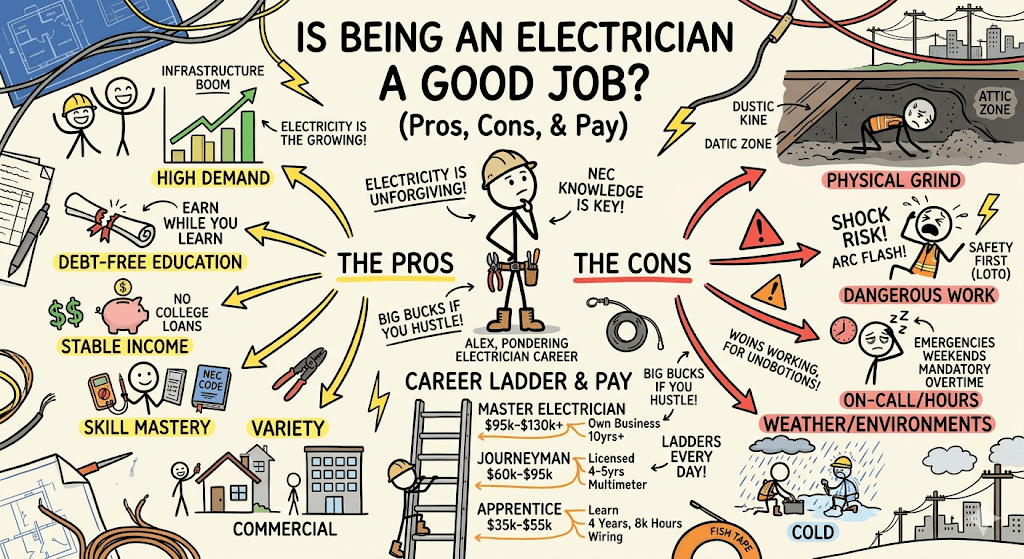
The American skilled trades sector is undergoing a historic transformation. As experienced professionals age out of the workforce and massive infrastructure projects break ground across the United States, the electrical trade has solidified its position as one of the most resilient and profitable career paths available. Stepping into this field requires more than just a willingness to work hard with your hands. It demands technical acuity, rigorous safety discipline, and continuous education.
At SpliceJobs, our goal is to provide contractors, journeymen, and aspiring apprentices with authoritative data. This comprehensive guide serves as a deep dive into the realities of the electrical profession. We will explore the nuanced daily operations, the rigorous path to certification, detailed earning potentials across the country, and the strategic choices that will define your career trajectory.
The True Scope of Daily Operations
The modern electrician operates at the critical intersection of heavy construction and advanced technology. The foundational duties extend far beyond pulling wire and installing receptacles. You are essentially bringing a structure to life to ensure that power flows safely and efficiently from the grid to the end user.
A typical day on a commercial site might involve interpreting dense blueprints to coordinate with HVAC technicians and pipefitters. You will be responsible for precise conduit bending, calculating complex load requirements, and troubleshooting intricate circuitry. Furthermore, every installation must adhere to the stringent regulations outlined in the NFPA 70 National Electrical Code (NEC), a comprehensive document updated frequently to reflect the latest safety standards.
The tools required for this level of precision are highly specialized. Beyond traditional hand tools, your daily arsenal will include digital multimeters, insulation resistance testers, laser levels, and heavy-duty hydraulic benders. To truly grasp the scope of the industry, many prospective tradespeople turn to resources like the Explore The Trades Electrician Career Guide to understand the fundamental differences between residential, commercial, and industrial specializations.
Navigating Apprenticeships and Formal Training
You do not simply wake up one day and decide to be an electrician. The path to entry is highly structured and heavily regulated to protect both the worker and the public.
The journey begins with an apprenticeship, a model that allows you to earn a living wage while receiving vital on-the-job training. Most electrical apprenticeships require a minimum of 8,000 working hours, which equals roughly four years of full-time employment, coupled with hundreds of hours of classroom instruction. Organizations like the Electrical Training ALLIANCE College Credit Program set the gold standard for this curriculum, blending theoretical physics and electrical theory with hands-on application.
For those looking to bypass traditional college debt, the federal government heavily supports these initiatives. You can explore federally recognized programs through the Apprenticeship.gov Electrical Power-Line Installers Listings, which connects aspiring tradespeople with vetted sponsors. During this phase, you are expected to master the basics under the direct supervision of a licensed journeyman or master electrician.
Financial Trajectory and Regional Economic Drivers
The financial outlook for this profession is exceptionally robust. According to pay data published by the Bureau of Labor Statistics, the median annual wage for electricians consistently outpaces the national average for other occupations, with projected job growth remaining incredibly steady.
However, your actual take-home pay is heavily dictated by your experience level and your geographic location.
The Apprentice Phase: First-year apprentices typically start between 40 to 50 percent of the standard journeyman rate. In states like Texas or Florida, this translates to roughly $18 to $22 per hour.
The Journeyman Milestone: Earning your state license unlocks significant earning power. Journeymen routinely command $35 to $50 per hour depending on the market.
The Master Electrician Peak: Those who achieve master status and move into project management or estimating easily break the six-figure threshold.
Location is arguably the biggest multiplier for your income. High-cost-of-living areas with massive infrastructure demands offer premium wages. Cities like New York, San Francisco, and Seattle boast some of the highest compensation packages in the country. To track shifting regional demand and commercial construction forecasts, experts often reference the Procore Construction Network Directory for real-time industry analytics.
The Strategic Divide: Organized Labor Versus Independent Shops
One of the most defining choices in an electrician's career is deciding between the union and non-union route. Both pathways offer distinct advantages and command deep loyalty from their respective workforces.
Joining a local chapter through the IBEW Construction Branch provides immense stability. Union members operate under collective bargaining agreements that secure clearly defined pay scales, robust pension plans, and comprehensive family healthcare. The structured environment protects workers and ensures that safety protocols are strictly enforced on every job site.
Conversely, the open shop sector offers a different type of freedom. Independent contractors, often represented by associations with resources like the NECA Career Center, provide incredible flexibility. In an open shop environment, your advancement is not tied to seniority. If you demonstrate exceptional skill and a tireless work ethic, you can negotiate higher wages directly and climb into leadership roles at an accelerated pace.
Mitigating the Real Risks of Electrocution and Arc Flash
We must address the inherent risks of the trade. Working with electricity is inherently dangerous, and complacency can be fatal. The risk of severe shock, arc flash explosions, and fatal falls from elevated workspaces is a daily reality.
Strict adherence to safety protocols is absolutely mandatory. Employers and technicians must comply with guidelines such as the OSHA Control of Hazardous Energy Standard, which details the rigorous lockout and tagout procedures required when servicing energized equipment. Furthermore, the NIOSH Construction Safety Program provides critical research and preventative strategies regarding repetitive motion injuries and proper ergonomic practices for tradespeople.
To stay current on evolving safety metrics and site management best practices, successful project managers frequently consult reports from the Construction Industry Institute Research Library.
Pivoting into High-Voltage and Smart Integrations
The electricians who will command the highest salaries over the next two decades are those who aggressively specialize. General wiring is the foundation, but advanced technology is the future.
If you want to maximize your value, consider pivoting into the booming renewable energy sector. Earning advanced credentials, such as becoming a NABCEP PV Installation Professional, will make you incredibly sought after for large-scale solar array installations and battery storage systems.
Similarly, the rise of smart buildings requires technicians skilled in low-voltage integration, data cabling, and building automation systems. Certifications like the ETA International Fiber Optics Installer credential validate your expertise in telecommunications and data infrastructure.
To stay ahead of the curve, true professionals never stop studying. Subscribing to deep-dive publications like the Electrical Contractor Magazine Business Section and utilizing the specific continuing education forums provided by Mike Holt Enterprises Free Resources ensures you remain an authoritative voice on the job site. Ultimately, the electrical trade is not just a job; it is a highly respected, intellectually demanding profession that builds the very foundation of our modern world.