How to Build Your Career as an Electrician in Florida

SpliceJobs Team
Published on 6/1/2026
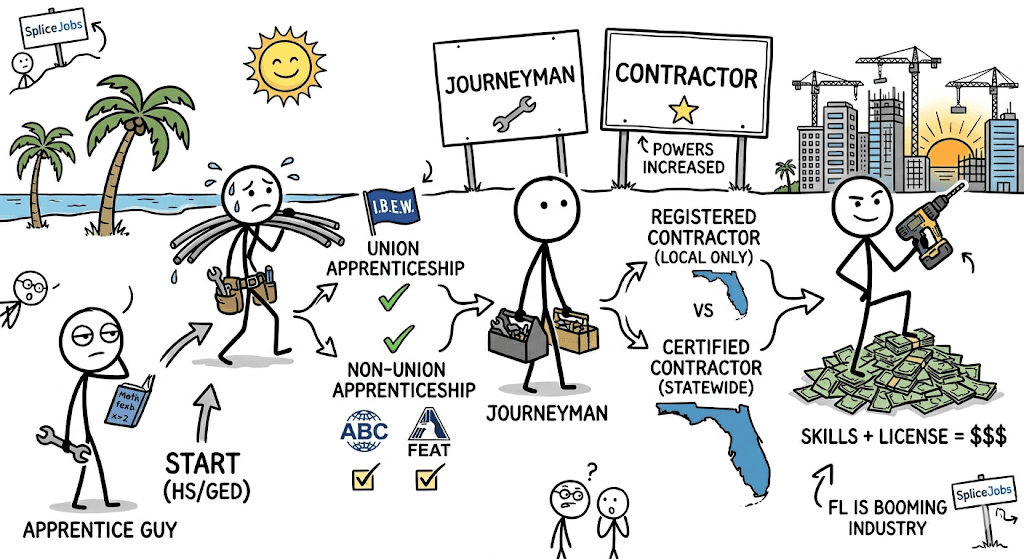
Florida is experiencing a massive construction boom. With thousands of new residents moving in every month, the state needs new housing developments, commercial highrises, and upgraded industrial facilities. This rapid growth, combined with the constant need to upgrade infrastructure for hurricane resilience, has pushed the demand for skilled tradespeople to an all time high.
If you want a career that pays well and offers unbeatable job security, becoming an electrician is one of the smartest moves you can make. Getting started in the electrical trade requires dedication, hard work, and the right roadmap. Let us break down exactly how to navigate the training, apprenticeships, and licensing requirements to build a highly profitable career in Florida.
Laying the Groundwork for Your Trade Career
You do not need a four year university degree to spark a successful career in this field. The foundational requirement to enter the trade is a high school diploma or a GED.Training directors and hiring managers want to see that you have a solid grasp of basic math. You will use algebra regularly to calculate voltage drops, figure out conduit fill capacities, and balance electrical loads across complex circuits.
Physical fitness is another major reality of the job. The electrical trade is physically demanding.You will spend long hours on your feet and climbing ladders. Working in Florida also means dealing with extreme heat and high humidity. You will often find yourself routing cables in unairconditioned buildings, tight hot attics, or outdoor commercial trenches. Knowing how to handle the heat, stay hydrated, and strictly follow OSHA safety standards is just as important as knowing your local building codes.
Choosing Your Training Pathway
The most reliable and proven way to become a professional is by completing an apprenticeship. This is an earn while you learn system. You work full time under the direct supervision of a licensed journeyman and attend classroom training a few evenings a week.A standard electrical apprenticeship lasts four to five years.By the end of the program, you will have logged roughly 8,000 hours of on the job training and at least 900 hours of classroom instruction.
You have three main avenues to get your foot in the door in Florida.
The Union Apprenticeship Route
The International Brotherhood of Electrical Workers (IBEW) partners with the National Electrical Contractors Association (NECA) to run joint training programs. These are known as JATC programs. Programs like the Central Florida JATC or Miami's Local 349 require you to pass an aptitude test covering reading comprehension and basic algebra. Union apprenticeships are highly respected and offer structured pay raises, excellent family health benefits, and a strong pension plan for your retirement.
The Merit Shop Route
Also known as the nonunion path, this route is run by industry organizations like the Independent Electrical Contractors (IEC) and Associated Builders and Contractors (ABC), as well as independent programs like Florida Electrical Apprenticeship & Training (FEAT). These organizations operate fantastic training centers across Florida. They place their apprentices with local private contractors. This route can sometimes offer a faster starting timeline if local contractors are hiring green helpers immediately.
Pre-Apprenticeship Trade Schools
Some people choose to attend a local Florida technical college for a certificate program before seeking an apprenticeship. Programs at schools like Florida State College or various county technical centers teach you the absolute basics of circuitry and job site safety. While this costs money upfront, it can make you a top pick for local employers who want a helper who already knows how to safely navigate a commercial job site.
Navigating Florida's Unique Licensing System
Florida handles electrical licensing differently from many other states. Licensing is split into local and statewide levels. Understanding this system early on is crucial for planning your career growth.
Earning Your Local Journeyman Card
After you finish your apprenticeship hours and classroom time, you will take a comprehensive exam to become a licensed journeyman electrician. In Florida, journeyman licenses are issued by individual counties or municipalities. They are not issued by the state government.
This means if you earn your journeyman card in Hillsborough County, you are legally recognized as a journeyman there. If you want to take a job up in Duval County or down in Miami Dade, you may need to apply for reciprocity or take their specific local exam. You must always check with the local building department where the job site is located.
Stepping Up to an Electrical Contractor
If your ultimate goal is to pull permits, bid on large projects, and run your own electrical business, you will need a contractor license. Florida offers two distinct types of contractor licenses.
Registered Electrical Contractor: This local license allows you to run a business, but only in the specific Florida counties where you hold a local competency card.
Certified Electrical Contractor: This is a powerful statewide license issued by the Florida Department of Business and Professional Regulation (DBPR). It allows you to contract work anywhere in the state. Getting this license requires passing a rigorous two part exam covering both trade knowledge and business finance.You must also prove your financial stability and carry specific workers' compensation and liability insurance.
Breaking Down Florida Electrician Salaries
The electrical trade rewards hard work and technical expertise. As a first year apprentice with no experience, you will likely start between $16 and $20 per hour. As you learn new skills, master complex wiring diagrams, and pass your annual exams, your employer will give you steady, scheduled raises.
Once you pass your exam and earn your journeyman license, your earning power jumps significantly. Florida journeymen generally earn between $55,000 and $80,000 a year for a standard 40 hour workweek.
Location and specialization heavily influence your paycheck. Metropolitan areas with heavy commercial development, like Tampa, Orlando, and Fort Lauderdale, often pay higher hourly rates to attract skilled labor. Furthermore, construction involves a lot of overtime. If you are willing to work weekends during a building boom or take on storm recovery shifts, your take home pay can easily exceed six figures.
You can also boost your value by mastering Florida specific niches. Earning certifications in solar panel installation, marine electrical systems for docks and boat lifts, or specialized whole home generator installations will make you an incredibly valuable asset to any local contractor.
Your Next Steps to Get Hired Today
The industry is actively looking for people who are willing to show up on time, work hard, and learn a highly technical craft. Take the time to brush up on your basic math skills, put together a clean resume highlighting any hands on experience, and start reaching out to local training centers.
When you are ready to find local opportunities, head over to SpliceJobs. We connect dedicated tradespeople with top tier electrical contractors who are actively hiring. Search for open apprenticeship slots and entry level helper positions in your specific area of Florida and get your new career moving today.