Essential Tools for First-Year Electrician Apprentices

SpliceJobs Team
Published on 4/24/2026
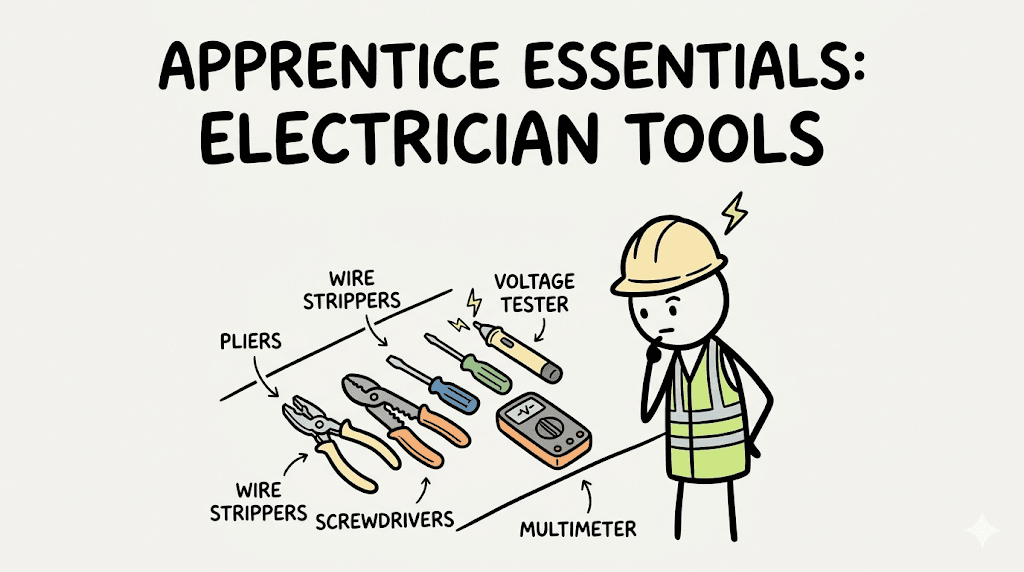
Stepping onto a commercial job site or into a residential rough-in for the first time is intimidating. You have your hard hat, your high-visibility shirt, and a lot to learn. One of the most immediate challenges for a first-year electrician apprentice is knowing what to carry in your tool pouch. Showing up empty-handed is a fast way to get sent back to the shop. Showing up with a rolling cart full of expensive, specialized testing equipment you do not know how to use will just earn you strange looks from the journeymen.
The goal for your first year is simple. You need the basic, reliable hand tools required to strip wire, turn screws, bend conduit, and keep yourself safe. Everything else can wait.
Building a Practical and Affordable Foundation
The electrical trade demands precision and safety. You will be pulling Romex, bending EMT (Electrical Metallic Tubing), and making up endless receptacles. The tools you buy now will take a beating. The rule of thumb for green apprentices is straightforward: buy affordable, professional-grade basics. When a tool wears out or breaks from heavy use, upgrade it to a premium version.
Contractors and unions often provide a specific tool list for new hires. Always consult your local Electrical Training Alliancechapter or your non-union shop foreman before buying anything. They will tell you exactly what is expected. In general, your focus should be on fundamental hand tools. Power tools like impact drivers, hammer drills, and band saws are typically provided by the contractor, though this varies by region and shop policy.
The Daily Carry: Must-Have Hand Tools
Your tool pouch is your mobile workstation. Every item in it must serve a distinct purpose. Carrying dead weight will only wear down your knees and back.
The Trusty Linesman Pliers If an electrician could only carry one tool, it would be the linesman pliers. These heavy-duty pliers are the workhorse of the trade. You will use them to cut copper conductors, twist wires together before applying a wire nut, pull fish tape through conduit, and occasionally knock on a junction box. Look for a pair with high leverage and a comfortable grip.
Dedicated Wire Strippers Do not try to strip wire with your knife or your linesman pliers. A good pair of dedicated wire strippers is essential for cleanly removing insulation without scoring the copper conductor inside. Scored copper creates a weak point that can heat up under a load, which is a massive fire hazard. Ensure your strippers have cutting holes sized for the common gauges you will see, typically 10 AWG to 14 AWG for residential and commercial lighting circuits.
A Core Set of Screwdrivers You will drive thousands of screws in your first year. A basic set of screwdrivers is mandatory.
Number 2 Phillips: The standard for most general-purpose screws.
Large Slotted (Flathead): Used for tightening locknuts on connectors and prying objects.
Small Slotted (Terminal Bug): Essential for wiring devices like outlets, switches, and terminating control wires.
Square Drive (Robertson): Heavily used in North America for panel lugs and specific device screws to prevent stripping.
Measuring and Marking Layout is everything in this trade. A rugged 25-foot tape measure is required daily. Many electricians prefer a tape measure with a rare-earth magnetic tip, which holds fast to steel studs and conduit while measuring long runs. You also need a torpedo level to ensure your boxes, conduit runs, and panels are perfectly plumb and level. The National Electrical Code (NEC)demands neat and workmanlike installations. A level ensures you meet that standard.
Life-Saving Diagnostics and Safety Gear
Electricity is an invisible hazard. You cannot see, smell, or hear it until it is too late. Your safety equipment is the most critical part of your kit.
Non-Contact Voltage Tester
Also known as a "tick tester" or "hot stick," this pen-sized tool detects the presence of alternating current (AC) voltage without requiring direct contact with bare wires. You must carry this in your shirt pocket at all times. Before you touch any wire, box, or panel, you test it. Never trust anyone who tells you a circuit is dead. Verify it yourself. Organizations like the Electrical Safety Foundation International (ESFI)constantly highlight the importance of verifying de-energized circuits to prevent fatal shocks.
Digital Multimeter
While the non-contact tester gives you a simple yes or no regarding voltage, a digital multimeter gives you the exact numbers. You will use this to measure voltage, check for continuity (making sure a circuit has a continuous path), and troubleshoot faults. You do not need an engineering-grade meter on day one, but you do need one that is properly rated for the voltages you will encounter, typically CAT III for building wiring.
Personal Protective Equipment (PPE)
Your employer is required to provide a safe working environment, but you are responsible for wearing your gear. The Occupational Safety and Health Administration (OSHA) and the National Safety Council (NSC) set strict guidelines and advocate for electrical worker safety.
Safety Glasses: Metal shavings from drilling panels and flying debris from pulling wire are constant threats.
Sturdy Work Boots: A good pair of composite-toe or steel-toe boots with electrical hazard (EH) rated soles is an absolute must.
Cut-Resistant Gloves: Handling sharp metal studs, knockout rings, and conduit edges will tear up your hands quickly.
Managing Your Load: Pouches and Belts
How you carry your tools dictates how you feel at the end of a ten-hour shift. Many first-year apprentices make the mistake of buying massive, heavy leather tool belts and filling them to the brim. This is a fast track to lower back pain.
According to the National Institute for Occupational Safety and Health (NIOSH), ergonomics plays a massive role in career longevity for tradespeople. Instead of a full belt, consider a smaller, modular tool pouch that clips to your side. Load it only with the tools you need for the specific task you are performing. Leave the heavy socket sets, large pipe wrenches, and specialized meters in your main tool bag securely locked in your vehicle or the site gang box.
Understanding Union vs. Non-Union Tool Lists
If you are joining the International Brotherhood of Electrical Workers (IBEW), your local union will have a strict, negotiated tool list. This list outlines the exact hand tools you are required to bring. The contractor provides everything else, including power tools, benders, and heavy equipment. You are strictly forbidden from bringing personal power tools to a union job site.
In a non-union (open shop) environment, expectations can vary. Some contractors provide all power tools, while others might expect you to slowly build up a kit of basic cordless tools, like a drill and impact driver, as you progress in your apprenticeship. Always clarify this during your hiring interview. The National Electrical Contractors Association (NECA) provides guidelines for contractors regarding equipping their workforce, but individual company policies rule the day.
Setting Yourself Up for the Long Haul
Your tools are an investment in your livelihood. Take care of them. Keep your pliers lubricated, replace the blades on your utility knife regularly, and never use a screwdriver as a cold chisel. The Bureau of Labor Statistics projects strong, continued demand for qualified electricians. By outfitting yourself with practical, durable gear, you are preparing yourself to meet that demand.
Focus on mastering the basic skills during your first year. Learn how to run a clean line of conduit. Learn how to splice wires tightly and efficiently. Your tool bag will grow as your responsibilities grow. For now, keep it light, keep it practical, and focus on working safely every single day. If you are exploring how to get started, resources like Apprenticeship.gov can guide you toward local training programs. The electrical trade rewards those who show up prepared and willing to work.