How to Get Electrician Jobs with No Experience in 2026

SpliceJobs Team
Published on 3/3/2026
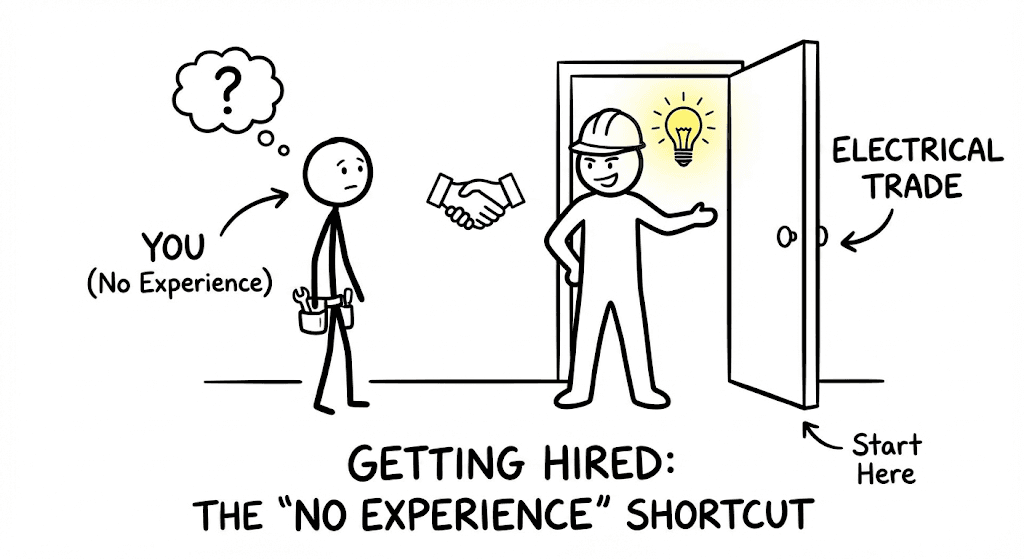
Entering the electrical trade without prior experience can feel like an impossible loop. Contractors want experienced hands, but you cannot gain experience without someone hiring you first. Fortunately, the electrical industry is facing a massive demographic shift in 2026. As senior journeymen retire, the demand for green workers to handle the exploding growth in smart home technology, electric vehicle charging infrastructure, and grid modernization has never been higher across the United States.
As part of our broader series, The Ultimate Guide to Electrician Career Paths in 2026, this guide from SpliceJobs will break down exactly how you can bypass the experience trap, get your foot in the door, and start logging your apprenticeship hours.
Stepping Into the Electrical Industry Without Prior Training

When a master electrician or project manager looks for a new hire with zero experience, they are not expecting you to know how to wire a three-way switch or calculate voltage drop. They are looking for reliability, mechanical aptitude, and a serious commitment to safety.
Your goal right now is not to get hired as a fully fledged electrician. Your goal is to get hired as an electrical helper, a material handler, or an unindentured apprentice. In these entry-level roles, your daily duties will consist of the heavy lifting that keeps the job site moving. You will spend your days organizing the work van, fetching locknuts and connectors, digging trenches for underground PVC conduit, and pulling THHN wire or Romex alongside a licensed journeyman.
You will be learning the precise layout of a commercial electrical room or the nuances of residential rough-in work. A typical morning might involve unloading spools of wire, organizing boxes of fasteners, and sweeping up drywall dust to ensure the workspace is safe. By the afternoon, you might be assisting with pulling heavy gauge wire through long runs of conduit or assembling lighting fixtures. Every task teaches you the rhythm of a construction site. By mastering the materials and observing the installation methods, you will naturally build the foundation required to transition into a formal, registered apprenticeship.
Two Distinct Pathways to Your First Electrical Paycheck
Depending on where you live in the United States, the path to logging your first official hour varies. You generally have two main avenues to pursue.
The Organized Labor Pipeline
The International Brotherhood of Electrical Workers operates Joint Apprenticeship and Training Committees across the country. You do not need experience to apply to a union apprenticeship. You only need a high school diploma with a passing grade in algebra. The selection process involves an aptitude test and a formal interview. You can learn more about this structured pathway through the Electrical Training Alliance.
While the training is exceptional and fully funded, the waitlists in 2026 are highly competitive. It can take several months to over a year to get dispatched to your first job, especially in highly populated states.
Open Shop Contracting and State-Level Trainee Programs
If you want to start working next week, the non-union or merit shop route is often much faster. You can directly approach independent electrical contractors and ask for a job as a helper. Once hired, the contractor sponsors your apprenticeship through an organization like the Associated Builders and Contractors.
Many states have formalized this entry-level status to make it easier for greenhorns to start legally working on job sites.
In Texas, you can easily apply for an Apprentice Electrician license online through the Texas Department of Licensing and Regulation before you even secure a job, proving to employers that you are ready to work.
If you live in California, you can register for an Electrician Trainee card. This allows you to legally work under a C-10 contractor while enrolled in a state-approved trade school. You can find the official registration steps on the California Department of Industrial Relations website.
Safety Certifications That Put Your Resume at the Top of the Stack
If your resume lacks trade experience, you must fill it with proof of your safety awareness. Contractors pay high insurance premiums, and a new worker with safety training is an immediate financial asset. Before you hand out a single resume, acquire these basic certifications.
OSHA 10: This ten-hour course covers basic workplace safety and is the absolute gold standard in the United States. You can find authorized training providers via the official OSHA Outreach Training Program portal.
First Aid and CPR: This shows you are prepared for job site emergencies and take crew safety seriously. A certification from the American Red Cross is universally recognized.
Fall Protection Training: Many commercial jobs require working on ladders or scissor lifts. Having basic fall protection knowledge gives you a distinct edge.
Having these credentials on your resume signals to an employer that you take the trade seriously and are ready to step onto a site without requiring a week of basic safety orientation.
Building Your Starter Tool Belt for Day One
You do not need to spend a fortune on power tools to get your first job. Contractors provide the expensive equipment like hammer drills and band saws. You are only expected to show up with basic hand tools and appropriate personal protective equipment.
Do not buy a pre-packaged 100-piece tool kit. Buy a few high-quality, trade-specific items. Do not show up with an overly bulky rig on your first day either. Start with a simple tool pouch that clips onto your belt.
The Core Hand Tools You Actually Need:
Lineman Pliers: The absolute staple of the trade, used for cutting, twisting, and gripping wire. The US industry standard is a pair of Klein Tools Lineman's Pliers.
Wire Strippers: Essential for removing insulation without damaging the copper conductor.
Screwdrivers: A robust flathead, a Phillips, and a square drive.
Non-Contact Voltage Tester: Your first line of defense to verify a circuit is dead. The Fluke Voltage Detector is highly recommended for job site reliability.
Tape Measure: A standard 25-foot tape with a magnetic tip is required for measuring conduit runs.
Safety Boots: Your most important investment. You will be on your feet for eight to ten hours a day. Look into reputable brands with safety toes like Thorogood Boots.
Analyzing Entry Level Wages and Financial Perks in 2026
You will not make journeyman wages in your first year. However, unlike traditional college pathways, you will be paid to learn. Wages scale directly with the hours you log and the technical school levels you complete.
Below is a general breakdown of starting wages for zero-experience helpers and first-year apprentices across different regions in the United States. To verify the latest national statistics, you can always check the Bureau of Labor Statistics.
US Region | Starting Hourly Wage (Zero Experience) | Potential First-Year Income |
National Average | $18.00 to $22.00 | $37,000 to $45,000 |
High-Demand Southern States (TX, FL) | $19.00 to $23.00 | $39,000 to $47,000 |
High Cost of Living Areas (NY, CA) | $22.00 to $28.00 | $45,000 to $58,000 |
Apprentices in the United States can also benefit from various financial support programs. Military veterans can use their GI Bill benefits to supplement their apprenticeship wages through programs like Helmets to Hardhats. Additionally, many merit shop contractors offer complete tuition reimbursement for your night school classes as long as you maintain good grades and stay with the company.
The Traditional Approach to Securing an Apprenticeship
The electrical trade still operates heavily on face-to-face interaction. Firing off generic resumes on massive job boards will yield poor results.
Instead, search for mid-sized electrical contractors in your area using local directories. You will need to bring printed copies of your resume with you. If you are not sure how to format it, read our guide on how to write a resume for an electrician apprentice job to ensure you are highlighting your safety certifications, mechanical hobbies, and reliability perfectly. Once your resume is ready, put on a clean pair of work boots and a plain t-shirt. Show up at the contractor's office at 6:30 AM before the crews dispatch for the day.
Ask to speak to the project manager, the field superintendent, or the owner. Tell them you are looking to start a career in the electrical trade, you have your basic tools, you have reliable transportation, and you are ready to work hard. In an industry starved for reliable manpower, that conversation alone is often enough to land you a trial run as a helper.