Electrician Job Roles and Descriptions Directory in 2026

SpliceJobs Team
Published on 2/24/2026
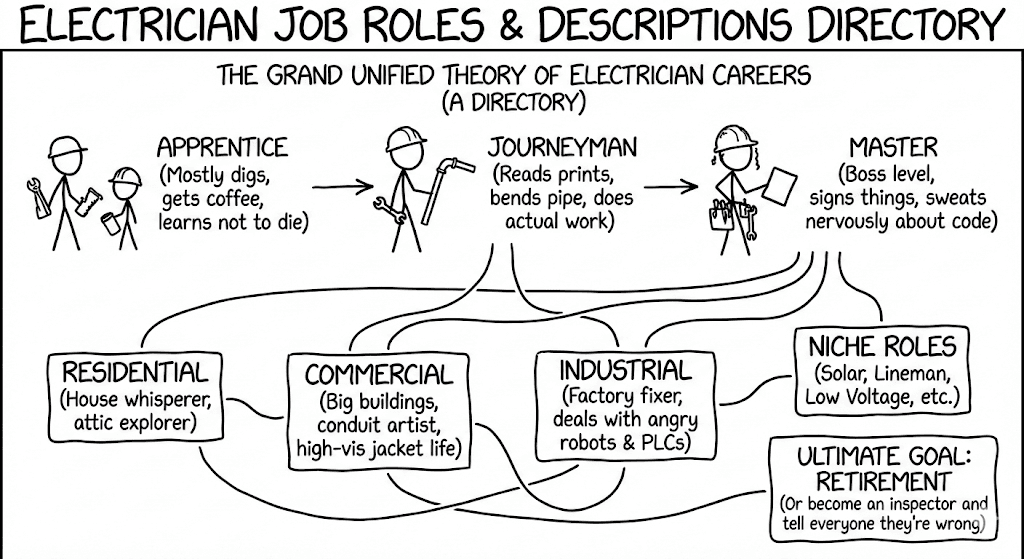
The electrical industry is not a monolith. It covers wiring smart homes, maintaining high-voltage transmission lines, and programming logic controllers in manufacturing plants.
This complete directory is your basic guide to the many roles in the electrical sector across North America. Whether you are an aspiring apprentice planning your career trajectory, a seasoned journeyman considering a pivot, or a contractor refining your hiring descriptions, this overview highlights the duties, environments, and skills required for each major electrical role.
The Foundational Hierarchy: Licensing and Experience Levels
Before diving into specific environments, it is crucial to understand the standard licensing progression that governs the electrical trade. Local jurisdictions heavily regulate these tiers to ensure safety and compliance with the National Electrical Code (NEC) or the Canadian Electrical Code (CEC).
The Pre-Apprentice Tier: Maximizing Site Efficiency
While the formal progression of the trade begins with the apprentice, the reality of a profitable job site often includes an introductory support role. High-volume electrical contractors frequently rely on unlicensed assistants to keep projects moving safely and efficiently. This pre-apprentice tier absorbs the logistical heavy lifting. By handling material management and site preparation, these workers allow licensed journeymen to focus entirely on complex circuitry and code compliance.
Before a worker even registers for a formal apprenticeship, many successful shops hire support staff to keep their job sites organized. If you need to scale your entry-level crew quickly, utilizing an optimized Electrician Helper Job Description Template is the most effective way to attract reliable talent ready to master the basics. Finding the right greenhorn ensures your highly paid technicians never waste time sweeping floors or searching for materials.
If you need to scale your entry-level crew quickly, a generic job posting will not cut it. You must utilize our field-tested entry-level electrician job description template to attract reliable talent ready to master the basics. Finding the right greenhorn ensures your highly paid technicians never waste expensive hourly rates sweeping floors or searching for materials.
Electrical Apprentice
The entry point for the trade is the apprenticeship. Apprentices work directly under the supervision of journeymen or master electricians. This phase combines hundreds of hours of classroom instruction with thousands of hours of on-the-job training.
Core Responsibilities:
Organizing materials, digging trenches for underground feeds, pulling wire through conduit, installing basic boxes, and mastering hand tools.
Key Focus:
Learning foundational circuitry, understanding basic safety protocols like Lockout/Tagout (LOTO), and developing efficient work habits.
Growth Path:
Apprentices often spend four to five years building the hours needed. They must meet these hours before taking their state or provincial licensing exam.
Building a successful career or a profitable contracting business begins with understanding these foundational roles. If you are a contractor looking to build your crew from the ground up, your very first step should be utilizing our optimized Electrician Apprentice Job Description Template to attract top tier greenhorns.
Journeyman Electrician
A journeyman has successfully completed an apprenticeship and passed a rigorous licensing examination. They are legally authorized to perform electrical work without direct supervision.
Core Responsibilities:
Reading blueprints, bending and installing Electrical Metallic Tubing (EMT), terminating electrical panels, troubleshooting complex circuits, and supervising apprentices.
Key Focus:
Executing installations according to strict code compliance and ensuring all work is safe, functional, and aesthetically professional.
Understanding these baseline responsibilities is just the starting point. Whether you are a contractor trying to attract top-tier talent or an electrician ready to benchmark your current skills, setting clear expectations is critical. Dive into our complete journeyman electrician job description template to see exactly what major employers demand on the job site right now.
Master Electrician
The master electrician represents the highest level of licensing. Achieving this status requires several years of experience as a journeyman followed by passing a comprehensive master-level examination.
Core Responsibilities:
Designing electrical systems, securing permits from local municipalities, overseeing large-scale projects, and managing teams.
Key Focus:
High-level problem solving, system engineering, business operations, and ultimate liability for project safety and compliance.
Expert Insight:
Many states require a business to employ at least one master electrician to operate legally as an electrical contracting company. Attaining this license is the most reliable gateway to business ownership.
Because a master electrician carries the license and the ultimate liability for your shop, attracting this caliber of leadership requires much more than a basic want ad. If you are a contractor ready to expand your operations and bring a license holder on board, use our comprehensive Master Electrician Job Description Template to build a posting that speaks directly to top-tier, code-compliant professionals.
Specialized Career Environments
Once an electrician achieves journeyman status, they often specialize in a specific environment. Each sector requires a distinct set of tools, knowledge, and daily routines.
Residential Electrician
Residential electricians focus on single-family homes, apartment complexes, and condominiums. This role requires excellent customer service skills, as workers frequently interact directly with homeowners.
Daily Duties:
Run non-metallic sheathed cable (Romex). Upgrade service panels for higher amperage. Install lighting fixtures. Integrate smart home technology.
Work Environment:
Primarily indoors with occasional outdoor service work. Spaces can be tight, requiring work in attics and crawlspaces.
Essential Tools:
Wire strippers, circuit testers, drywall saws, and voltage meters.
Commercial Electrician
Commercial electricians build and maintain the power systems for retail centers, office buildings, schools, and hospitals. The scale of the work is significantly larger than residential projects.
Daily Duties:
Work with three-phase power systems. Install heavy-duty conduit. Pull thick gauge wire, like THHN. Set up complex lighting control panels.
Work Environment:
Active construction sites, varying indoor and outdoor conditions, and frequent use of aerial lifts.
Essential Tools:
Conduit benders, fish tape, laser levels, and advanced digital multimeters.
Industrial Electrician
Industrial work involves the highest complexity regarding machinery and automation. These electricians work in factories, processing plants, and mining operations.
Daily Duties:
Installing and troubleshooting motors, variable frequency drives (VFDs), transformers, and Programmable Logic Controllers (PLCs).
Work Environment:
Highly demanding environments that may include exposure to extreme temperatures, loud noises, and hazardous materials. OSHA safety protocols are paramount.
Essential Tools:
Insulation resistance testers (meggers), phase rotation meters, and specialized calibration equipment.
Low Voltage (Voice/Data/Video) Technician
Also known as limited energy electricians, these professionals handle systems that operate on less than 50 volts.
Daily Duties:
Install fiber optic cables and Cat6 network infrastructure. Install fire alarm systems, CCTV, and access control systems.
Work Environment:
Usually cleaner environments like finished office spaces or server rooms.
Key Focus:
Precision termination, signal testing, and network architecture.
High-Voltage Utility Work: The Lineman Electrician
While inside wiremen handle the power once it reaches a building, lineman electricians operate on the front lines of the electrical grid. They are the utility specialists who keep the lights on for entire cities.
Daily Duties: Installing and repairing high-voltage overhead transmission lines, splicing underground cables, erecting utility poles, and servicing massive substations and distribution transformers.
Work Environment: Outdoors and at extreme heights, often in severe weather conditions like blizzards or hurricanes to restore power during emergencies. Safety rigging and strict live-line protocols are a daily reality.
Essential Tools: Hot sticks, insulated climbing gear, hydraulic crimpers, and bucket trucks.
Career Deep Dive: Ready to see if you have the stomach for working with hundreds of kilovolts in the open air? Read our full breakdown: What is a Lineman Electrician?
The Entry Point to New Construction: The CW Electrician
Before systems can be maintained, they have to be built. If you are looking to get your foot in the door on major commercial and industrial build-outs without a traditional apprenticeship, the Construction Wireman track is a primary route. Learn how this field-first role works, what it pays, and how it jumpstarts your career in our comprehensive breakdown: What is a CW Electrician?
Maintenance Electrician
While construction electricians are focused on building brand new systems from the ground up, maintenance electricians are tasked with keeping existing facilities alive. When a manufacturing plant goes dark or a critical mechanical room in a high rise building fails, these professionals are the first ones on the scene. They are the ultimate problem solvers of the electrical trade.
Daily Duties: Diagnosing complex electrical faults in aging systems, testing facility switchgear, replacing worn out motor control centers, and executing strict preventative maintenance schedules to avoid catastrophic failures.
Work Environment: Fast-paced operational facilities where equipment downtime can cost a company thousands of dollars per minute. You will work in active factories, boiler rooms, and automated distribution hubs.
Essential Tools: True RMS multimeters, thermal imaging cameras to spot loose connections, and heavy duty safety locks.
Career Deep Dive: Want to know exactly what it takes to break into this high demand specialty? Read our complete guide to the Maintenance Electrician Job Description to explore salary expectations, required certifications, and the daily challenges of the role.
Advanced and Niche Roles
For electricians who want to move beyond pulling and terminating, the industry offers several specialized technical and administrative paths.
Solar Photovoltaic (PV) Installer
As renewable energy grows, this specialized role has seen massive demand. PV installers assemble, set up, and maintain rooftop or ground-mounted solar panels. They must understand DC to AC power inversion, battery storage systems, and specialized roof-mounting techniques.
Electrical Estimator
Estimators transition from the field to the office. They analyze blueprints and specifications to determine the material, labor, and time required to complete a project. An accurate estimator is the lifeblood of a profitable electrical contracting firm. They must have a deep understanding of field operations to predict potential roadblocks and calculate competitive, yet profitable, bids.
Electrical inspector
usually work for city, county, or state governments. They visit job sites to ensure work follows the NEC or CEC. They check panel clearances, wire sizing, grounding systems, and overall workmanship. This role requires encyclopedic knowledge of building codes and the authority to halt projects that present safety hazards.
Shared Priorities: Safety and Continuous Learning
Regardless of the specific role, every successful electrical career is built on a foundation of rigorous safety adherence. Hazards like arc flash, severe shock, and electrical fires are daily realities. Master OSHA rules.
Follow Lockout/Tagout steps. Use Personal Protective Equipment (PPE) correctly. These are required across the SpliceJobs directory.
The electrical field is dynamic. With the fast growth of EV charging stations, smart grids, and renewable energy, these job descriptions will keep evolving.