Journeyman Electrician Job Description Template

SpliceJobs Team
Published on 4/9/2026
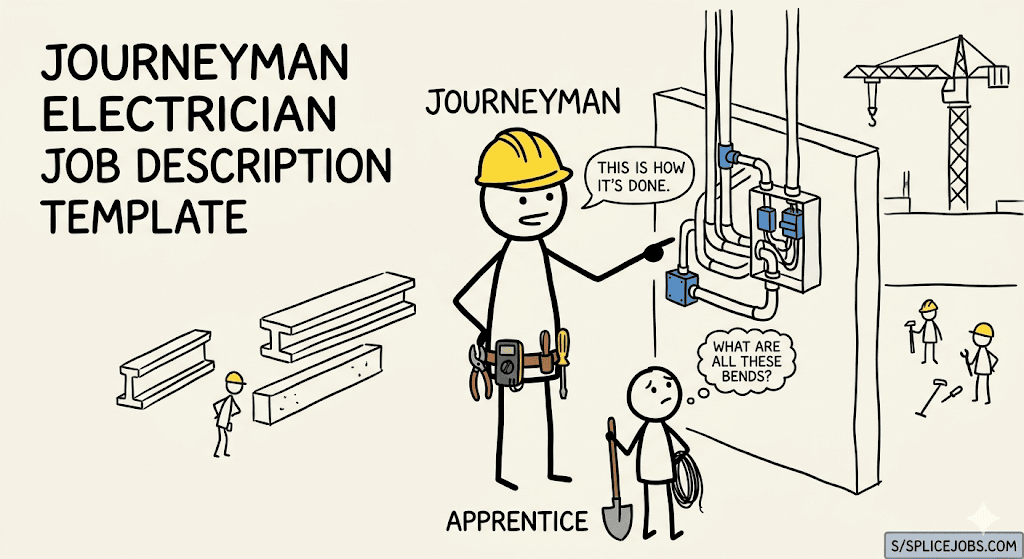
If you have spent any time scrolling through standard job boards, you already know the frustration. You click on a listing for a journeyman electrician, and it reads like it was written by an HR representative who thinks a wire stretcher is an actual tool you can buy at the hardware store. It is annoying for the sparkies looking for work, and it is counterproductive for the contractors trying to hire actual talent.
Today on SpliceJobs, we are fixing that problem. We are putting together a highly accurate, no-nonsense journeyman electrician job description template. If you are an employer, you can use the framework below to attract top-tier professionals. If you are an apprentice or a seasoned journeyman, you can use this to benchmark your skills, update your resume, and understand exactly what is expected on modern job sites in major markets from New York to Texas.
The Reality of the Role on the Job Site
A journeyman electrician is the absolute backbone of the electrical trade. You have put in your 8,000 hours fetching material, sweeping floors, and learning the ropes as an apprentice. You possess a state-issued license. You no longer need someone looking over your shoulder to make sure your polarity is correct. You are running your phase of the project, executing the plan, and making critical decisions on the fly.
This role requires a deep understanding of electrical theory combined with intense practical application. You are not just stapling Romex in a residential basement. A true journeyman is installing complex switchgear, wiring 480V three-phase motor control centers, bending intricate offsets in rigid conduit, and troubleshooting dead shorts in massive commercial facilities. You must interpret complex blueprints, draft your own as-built sketches, and guarantee that every termination is tight, right, and safe. For a broad look at how this role impacts the wider economy, you can view the occupational outlook from the Bureau of Labor Statistics.
Real-World Examples: The Journeyman Difference
To truly understand what separates a licensed journeyman from a third-year apprentice, let us look at two real-world scenarios you might see on any major job site today.
Example 1: The Commercial Retrofit in Downtown Chicago Imagine a scenario where a contractor is upgrading an outdated electrical service in a high-rise office building. An apprentice might know how to pull the heavy copper feeds, but the journeyman is the one orchestrating the entire shutdown. The journeyman calculates the exact conduit fill, plans the rigid pipe routing to avoid existing HVAC ductwork, and coordinates with the utility company. When a discrepancy appears between the outdated blueprints and the actual wall framing, the journeyman pivots instantly. They fabricate complex three-point saddle bends on the spot to navigate around a newly installed plumbing line, ensuring the entire conduit run remains perfectly level, strapped to code, and ready for inspection before the Monday morning deadline.
Example 2: Mentorship and Safety Protocol in Houston On a sprawling industrial build in Texas, a first-year apprentice is preparing to open a junction box to splice a 277V lighting circuit. The journeyman notices the apprentice is relying strictly on a non-contact voltage tester (a "death stick") and has not physically verified the breaker lock. The journeyman immediately halts the work. They do not just yell; they use this as a teaching moment. The journeyman walks the apprentice back to the panel, walks through the full Lockout/Tagout procedure, and demonstrates how to verify zero energy using a true-RMS multimeter. This direct intervention prevents a potentially lethal shock and ensures the apprentice learns the unyielding importance of site safety rules.
Strict Adherence to Code and Site Safety
Code compliance is an enormous part of this job. Every wire pulled and every box mounted must adhere strictly to the National Electrical Code. An inspector will shut your site down immediately if your grounding and bonding are compromised or if your conduit fill calculations are incorrect.
Furthermore, site safety is entirely non-negotiable. You are dealing with invisible, lethal energy every single day. Employers expect a journeyman to lead by example when it comes to safety protocols. This means properly executing Lockout/Tagout procedures before opening any panel. You can review the exact compliance metrics for hazardous energy control via the OSHA Lockout/Tagout standards. Additionally, because you will spend half your life on scissor lifts, extension ladders, and scaffolding, maintaining strict adherence to OSHA Fall Protection guidelines is a daily mandate.
The Essential Toolkit and Physical Demands
A professional shows up equipped for the task. Employers expect you to carry the right-hand tools, including your reliable Lineman pliers, a high-quality true-RMS multimeter, insulated screwdrivers, a razor knife, and precision wire strippers. However, the job also requires mastering heavy power tools. You will be operating hydraulic conduit benders, threading rigid pipe, running heavy hammer drills, and using tuggers to pull 500 MCM cable through underground PVC.
Because of the tools and the environment, protecting yourself from arc flash and long-term physical damage is vital. We always recommend reviewing toolbox talk materials from the NIOSH Electrical Safety program. The physical demands are intense. You will find yourself squeezing into 120-degree attics during the summer and trenching for underground service feeds in the freezing rain. You need solid knees, a strong back, and the stamina to be on your feet for ten to twelve hours a day.
Qualifications, Training, and The Apprenticeship Pipeline
You do not simply wake up one morning and decide to call yourself a journeyman. It requires years of rigorous, structured training. Most professionals in this space have completed comprehensive programs recognized by organizations like the Electrical Training Alliance or the National Center for Construction Education and Research.
Following your apprenticeship, passing a rigorous state licensing exam is the final hurdle. Licensing requirements vary significantly across the United States. If you look at the Texas Department of Licensing and Regulation, you will see their specific on-the-job hour requirements and exam structures. You can compare that to the highly strict certification and continuing education standards maintained by the California Department of Industrial Relations.
The SpliceJobs Copy-and-Paste Job Post Framework
Contractors, feel free to adapt the following bullet points for your next hiring post to ensure you attract serious tradespeople.
Core Daily Responsibilities
Read, interpret, and execute electrical blueprints, schematics, and single-line diagrams.
Install, maintain, and troubleshoot commercial and industrial electrical systems, including switchgear, transformers, and motor controls.
Expertly bend and route EMT, PVC, and rigid conduit.
Mentor, train, and supervise apprentices, ensuring their work meets quality and code standards.
Perform rigorous testing on electrical systems using multimeters, meggers, and circuit tracers to identify and resolve faults.
Mandatory Requirements
Active Journeyman Electrician License in the state of employment.
Minimum of 4 to 5 years of documented on-the-job training and commercial/industrial experience.
OSHA 10 or OSHA 30 Construction Safety Certification.
Deep, working knowledge of the current National Electrical Code.
Valid driver's license and reliable transportation to various job sites.
Moving Up the Ladder in the Electrical Trade
The best part about earning your journeyman ticket is the incredible career mobility it provides. You are highly employable in virtually any city in the country. If you eventually want to put the tool belt away, you can study for your master electrician license. From there, you can transition into a role as a site foreman, an electrical estimator, a project manager, or even launch your own contracting business.
Many driven professionals also choose to engage heavily with industry groups like the National Electrical Contractors Association or the International Brotherhood of Electrical Workers to network, negotiate better regional wages, and continue their professional development.
Whether you are an employer trying to staff a massive commercial build or a tradesman looking to secure your next high-paying role, understanding the true scope of a journeyman is the first step. Over at SpliceJobs, our goal is to bridge the gap between skilled labor and excellent contractors. Keep your conduit runs perfectly straight, double-check your connections, and stay safe out there on the site.