What Is a CW Electrician

SpliceJobs Team
Published on 7/11/2026
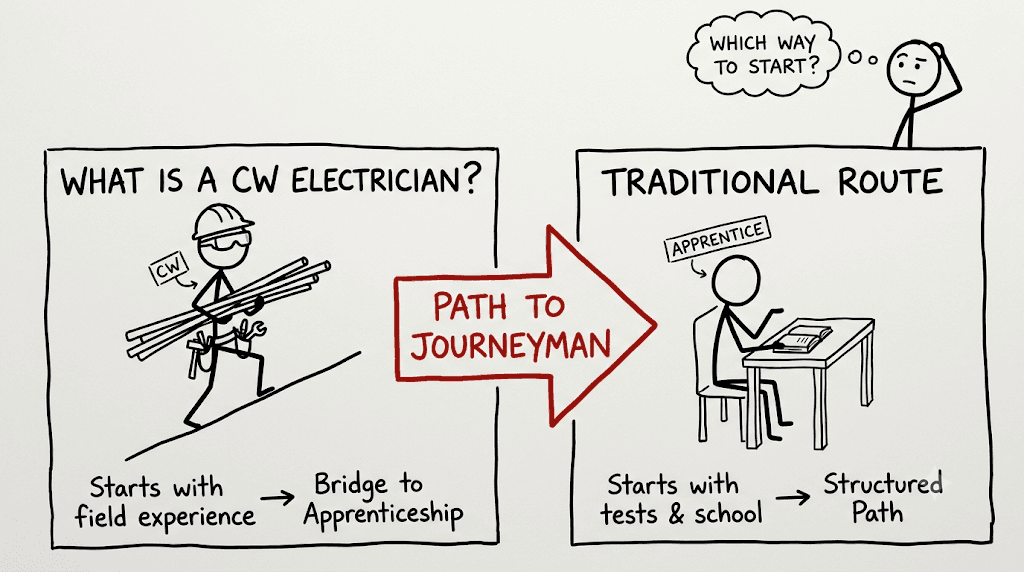
If you are looking to break into the electrical trade, you have probably run across a lot of acronyms. Between apprentices, journeymen, and masters, the path seems straightforward until you see job postings for a CW electrician.
CW stands for Construction Wireman. It is a specific classification used primarily within the International Brotherhood of Electrical Workers (IBEW) and the National Electrical Contractors Association (NECA) framework. This role serves as a crucial bridge for individuals who want to work on commercial and industrial job sites but might not have taken the traditional four-to-five-year apprenticeship route yet.
For high school graduates, diploma holders, or anyone looking to switch careers into the skilled trades, understanding what a Construction Wireman does is the first step toward building a long-term, high-paying career on the tools.
What Exactly Does a Construction Wireman Do?
A CW electrician is an field worker who handles hands-on electrical installations under the direct supervision of a licensed Journeyman Wireman. While you are not a fully licensed electrician yet, you are also not in the official Joint Apprenticeship and Training Committee (JATC) program.
The day-to-day duties of a CW electrician depend heavily on your experience level, which is usually ranked from CW-1 up to CW-4. On a typical commercial job site, your tasks will generally include the following:
Material Handling: Staging materials, moving heavy conduits, and organizing the gang box so the journeymen have the right parts for the run.
Running Conduit: Bending and installing Electrical Metallic Tubing (EMT) or rigid conduit along walls and ceilings.
Wire Pulling: Feeder pulls and branch circuit pulling through newly installed raceways.
Fixture Installation: Mounting and wiring light fixtures, receptacles, switches, and junction boxes.
Site Safety: Maintaining a clean workspace to prevent trips and falls, which aligns with strict OSHA standards.
You will use standard hand tools every day. A solid tool pouch for a CW includes linesman pliers, wire strippers, a channel lock pair, a torpedo level, a tape measure, and a reliable utility knife.
The Difference Between a CW and an Apprentice
It is easy to confuse a Construction Wireman with a registered apprentice, but their career tracks and structural setups are quite different.
Feature | Construction Wireman (CW) | Registered Apprentice (JATC) |
Hiring Process | Often hired directly through a local union hall or contractor based on immediate job site demand. | Must pass a competitive aptitude test, interview process, and wait for an opening slot. |
Classroom Instruction | Often optional or done through independent modules depending on the local union guidelines. | Mandatory paid or night school classes (usually 180 hours per year) paired with on-the-job training. |
Pay Scale Structure | Based on accumulated field hours and evaluated skill levels. | Strict, guaranteed percentage steps based on completing both school semesters and work hours. |
Ultimate Goal | Gain enough field experience to test out as a Journeyman or transition into the official apprenticeship. | Graduate directly into a licensed Journeyman Wireman role with a state credential. |
The CW program is often used as a proving ground. Many workers take a CW job to earn a steady paycheck and prove their work ethic to local contractors while they wait for the next JATC apprenticeship application window to open.
Pay Scales and Regional Earnings for CW Electricians
Your earning potential as a Construction Wireman depends on two main factors: your geographic location and your total hours on the job. Because CW positions are structured by union agreements, your pay scale increases as you move up the ranks from CW-1 to CW-4.
Experience Breakdown
CW-1 and CW-2 (0 to 2,000+ hours): Entry-level tiers. You will start at a set percentage of the local journeyman wage, which often beats retail or fast-food entry positions.
CW-3 and CW-4 (4,000 to 8,000 hours): Experienced hands. At this stage, you can bend pipe efficiently, read basic blueprints, and work with minimal supervision. Your pay will reflect this independence.
Regional and Union Factors
In areas with a high cost of living or strong union presence, like the Northeast or the West Coast, starting wages for a CW can be significantly higher than in the South or parts of the Midwest.
Working as a union CW also means you get access to healthcare benefits and retirement contributions paid by the contractor on top of your hourly check. Non-union contractors have similar helper classifications, but their pay scales are determined by individual employer rates rather than a collective bargaining agreement.
How to Move Up and Advance Your Electrical Career
The CW designation should not be your final destination. It is a stepping stone. If you want to maximize your income and job security, you need to use your time as a CW to build a permanent career. Here is how you do it:
Keep a Detailed Log of Your Hours
Every state and local jurisdiction requires proof of on-the-job training hours to let you sit for a Journeyman exam. Make sure your employers are accurately reporting your hours to the local union hall or state licensing board.
Transition to the JATC Apprenticeship
Use your time on-site to learn from the journeymen. Ask questions about circuitry, load calculations, and the National Electrical Code (NEC). When you apply for the official apprenticeship, your real-world experience as a CW will make you a standout candidate during the interview.
Focus on Safety and Reliability
The fastest way to get laid off is to show up late or ignore safety protocols. Always wear your hard hat, safety glasses, and boots. Show the foreman that you can be trusted to work safely without someone watching over your shoulder every minute.
Looking for your next opportunity on the tools? Whether you are looking for an entry-level wireman position or a senior role, check out the latest listings on SpliceJobs to find electrical contractors hiring in your area right now.