Maintenance Electrician Job Description

SpliceJobs Team
Published on 4/29/2026
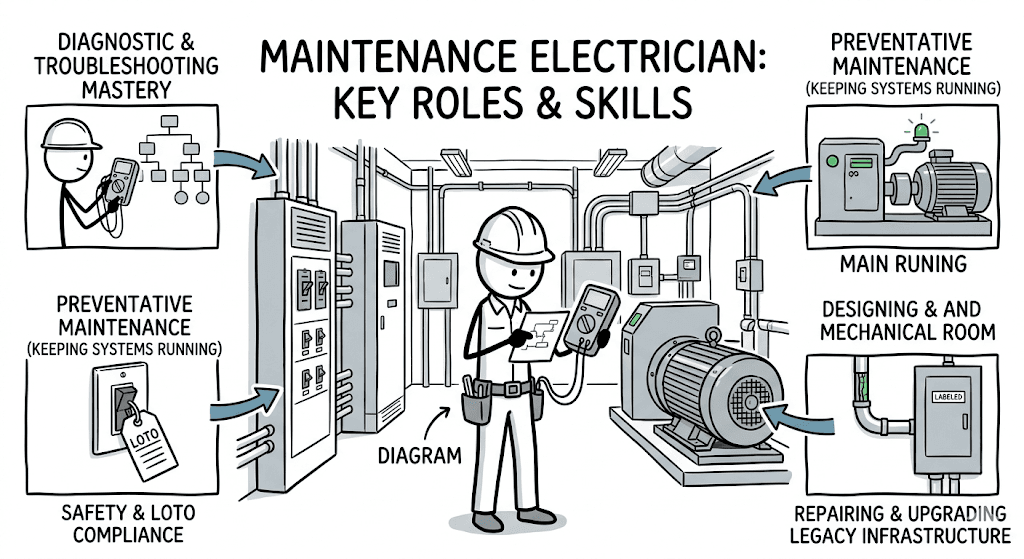
Industrial plants and large commercial facilities rely on a continuous supply of power to operate. When a massive motor trips offline or a critical control panel fails, production halts and companies lose money by the minute. This is the exact moment a maintenance electrician becomes the most important person in the building.
Unlike construction electricians who focus on installing new wiring in empty frameworks, maintenance electricians are the ultimate problem solvers of the electrical trade. They keep existing legacy systems running, diagnose incredibly complex faults, and prevent catastrophic mechanical failures before they happen. If you are looking to hire a professional for your facility or considering this career path, understanding the full scope of this job is absolutely critical.
Core Responsibilities on the Facility Floor
A typical day for a maintenance professional is rarely predictable. The primary role is ensuring the electrical infrastructure of a building or plant operates safely and efficiently. You might spend your morning testing voltage on a massive assembly line and your afternoon replacing outdated breaker panels in a commercial office complex.
Daily responsibilities generally include:
Reading and interpreting complex technical diagrams and blueprints to understand how older systems are actually wired.
Testing electrical components for continuity, proper voltage, and resistance using specialized diagnostic meters.
Repairing or replacing worn wiring, faulty industrial switches, and broken relays.
Upgrading older facility infrastructure to guarantee it meets current National Electrical Code or Canadian Electrical Code requirements.
Calibrating complex instrumentation and variable frequency drives that control heavy machinery.
The Necessary Skill Set and Tool Bag
This job requires significantly more than just pulling wire through rigid conduit. It demands sharp critical thinking and a deep understanding of electrical theory.
Troubleshooting is the single most vital skill a maintenance professional can possess. When a machine goes down on a factory floor, there is rarely a manual pointing to the exact problem. The electrician must use logic and a deep understanding of three phase power to isolate the issue. They track the electrical current from the main switchgear all the way down to the individual sensors to find the exact point of failure.
Preventive maintenance is equally important. Replacing a heavily worn contactor before it completely burns out saves a company thousands of dollars in unplanned downtime. Maintenance electricians must strictly adhere to rigorous safety standards set by OSHA to protect themselves and other facility workers. This includes an absolute mastery of Lockout/Tagout procedures to ensure machines cannot be energized while someone is working inside them.
Furthermore, automation knowledge is becoming mandatory. Modern facilities rely heavily on Programmable Logic Controllers. Understanding how to troubleshoot a PLC network and read ladder logic is a massive advantage in today's job market.
Exploring Salary Expectations and Earning Potential
Compensation for maintenance electricians is highly competitive. Earnings depend heavily on experience, location, and the specific industry you serve.
Pay by Experience Level
Apprentices starting out will generally earn a set percentage of the journeyman wage. As you log your hours and pass your schooling levels, your pay scales up reliably. A fully licensed journeyman maintenance electrician can expect to earn anywhere from $65,000 to over $100,000 annually. Senior technicians and electrical supervisors often push well beyond the six figure mark, especially when overtime and shift differentials are factored in.
Regional Variations Across North America
Location dictates demand. Heavy manufacturing hubs in the American Midwest and resource rich provinces in Canada often pay top dollar to keep their operations running smoothly. Conversely, commercial maintenance roles in standard metropolitan areas might offer slightly lower hourly rates but provide highly stable, regular daytime hours.
Union Versus Non Union Shops
Electricians have the option to organize through trade unions like the IBEW. Union roles typically provide excellent medical benefits, standardized pay scales based on seniority, and robust pension plans. Non union roles often offer more flexibility in negotiating individual salaries and allow for faster career advancement based solely on skill and merit. Both paths offer highly lucrative and stable careers.
Tips for Increasing Your Income
If you want to maximize your earning potential in electrical maintenance, specialization is the key. Earning a dual ticket in instrumentation, mastering PLC programming, or obtaining a high voltage splicing certification makes you an invaluable asset. Additionally, being willing to work night shifts or take on emergency call out duties will significantly boost your annual take home pay.
Real World Maintenance Electrician Job Descriptions
If you are an employer drafting a job posting or a tradesperson looking to see what companies are demanding, here are two practical examples of job descriptions tailored for different environments.
Example 1: Industrial Maintenance Electrician
Position: Industrial Maintenance Electrician (Night Shift)
Location: Manufacturing Facility
Job Overview:
We are seeking a highly skilled Industrial Maintenance Electrician to ensure the reliable operation of our automated production lines. You will be responsible for diagnosing faults, performing preventative maintenance, and upgrading legacy electrical systems in a fast paced manufacturing environment.
Key Responsibilities:
Troubleshoot and repair three phase motors, variable frequency drives, and motor control centers.
Read and interpret electrical schematics, P&ID drawings, and ladder logic.
Perform routine thermal imaging and megger testing on critical facility switchgear.
Strict adherence to all facility safety protocols and Lockout/Tagout procedures.
Requirements:
Valid state or provincial Journeyman Electrician License.
Minimum of 3 years of experience in an industrial manufacturing setting.
Strong working knowledge of PLC troubleshooting (Allen Bradley preferred).
Ability to work comfortably on aerial lifts and in confined spaces.
Example 2: Commercial Facilities Maintenance Electrician
Position: Commercial Maintenance Electrician
Location: Property Management Group
Job Overview:
Our property management group requires a dedicated Commercial Maintenance Electrician to oversee the electrical integrity of our corporate office high rise portfolio. The ideal candidate will handle everything from lighting control systems to preventative maintenance on backup power generators.
Key Responsibilities:
Inspect, test, and repair commercial lighting circuits, emergency exit signs, and ballast systems.
Perform scheduled maintenance and load testing on diesel backup generators and ATS units.
Troubleshoot low voltage access control systems and HVAC electrical feeds.
Maintain accurate digital logs of all work orders, parts used, and time spent on repairs.
Requirements:
Valid state or provincial Journeyman Electrician License.
Proven experience in a commercial building maintenance role.
Excellent customer service skills and the ability to communicate technical issues to building managers.
Strong understanding of local building codes and fire alarm system integrations.