How to Write an Entry-Level Electrician Job Description

SpliceJobs Team
Published on 4/1/2026
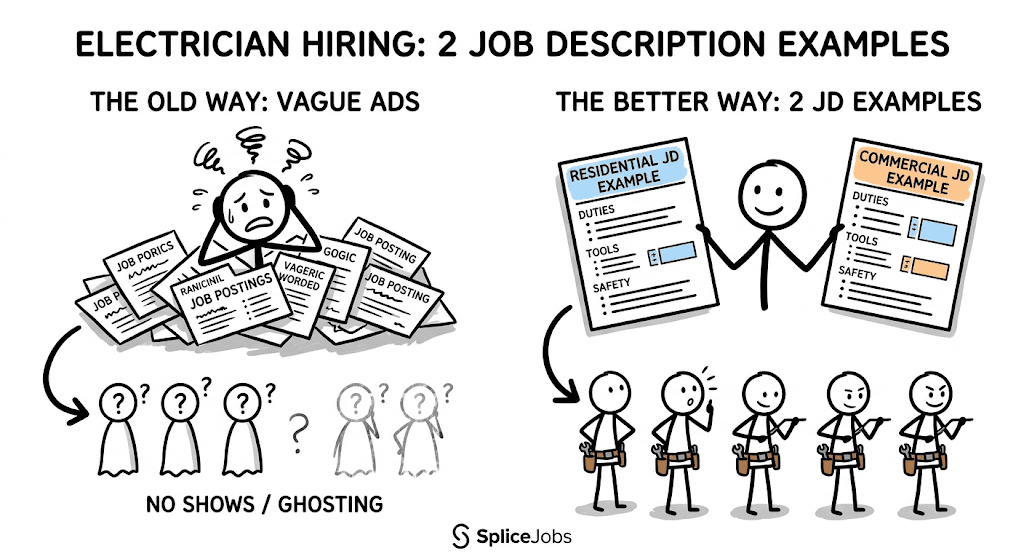
Hey SpliceJobs contractors and employers. We hear it every day on the boards. Finding a greenhorn who actually shows up on time on a Monday morning is getting harder and harder. If you want to attract a solid entry-level electrician, your job posting needs to be crystal clear. You cannot just copy and paste a generic corporate template and expect to reel in top-tier apprentice talent.
When you write an entry-level electrician job description, you are not just listing tasks. You are setting the baseline culture for your newest employee. Let us break down exactly how to write a compelling, accurate, and highly effective job description that weeds out the flakes and attracts individuals ready to work.
Laying Out the Core Job Duties Clearly
Your job description needs to strip away the glamour. A lot of young candidates watch social media influencers bending a perfect pipe and think that is their first day on the job. You need to outline the daily grind so there are no surprises when you hand them a broom or a shovel.
Here are the specific duties you should include in your posting to ensure they know what they are signing up for:
Job Site Staging and Material Management: Make it clear that their primary role is supporting the journeyman. They will be responsible for unloading the truck, organizing the gang box, and keeping the work area free of trip hazards.
Heavy Lifting and Cable Pulling: State plainly that they will be pulling heavy NM-B wire for residential builds or dragging THHN through commercial conduit. Let them know physical stamina is a non-negotiable requirement.
Basic Rough-In Tasks: Explain that they will learn to mount junction boxes, drill studs, and secure cables
Groundwork and Trenching: If your shop does underground service laterals or commercial slab work, put trenching and PVC gluing front and center in the ad.
Setting these expectations early reduces your turnover rate immensely. When an applicant knows they will be sweating in a ditch on Tuesday, they are less likely to quit on Wednesday.
Establishing Tool Requirements for the First Year
One of the biggest areas of confusion for new hires is the tool list. Your job description must explicitly state what the shop provides and what the apprentice is expected to bring on their first day.
You do not want a new guy showing up empty-handed, expecting you to hand them a brand-new impact driver. Outline a basic required hand tool list right in the job ad. Tell them they need a quality pair of Lineman pliers, and feel free to recommend industry standards, so they know you value quality. They should also arrive with wire strippers, diagonal cutters, a tape measure, and insulated screwdrivers.
You should also clarify that your company will provide the heavy machinery, power tools, and eventually, high-end testing equipment. While every electrician eventually needs a good multimeter, let them know you will handle the live-voltage testing while they are still learning the ropes.
Non-Negotiable Safety and Environment Expectations
Let us be honest about the workplace environment. Electrical work happens in extreme conditions. Your job posting needs to reflect the reality of your specific region.
If you run a residential shop in Texas, explicitly state that they will be working in 120-degree attics during the summer. If you handle commercial projects in Chicago, mention the freezing winter drafts on high-rise decks before the windows go in.
More importantly, your job description must highlight your company safety culture. Mention that strict adherence to OSHA electrical safety standards is a condition of employment. Detail your requirements for Personal Protective Equipment, including hard hats, safety glasses, and safety-toe boots. You should also briefly mention that they will undergo training for Lockout/Tagout procedures, as the National Institute for Occupational Safety and Health(NIOSH) standards regarding arc flash and shock hazards are zero-tolerance policies in any reputable shop.
Highlighting the Training Pathway and Growth Potential
Why should a smart, hard-working kid choose your electrical contracting business over another trade? You need to sell the career path. The best applicants are not just looking for a paycheck. They are looking for an education.
If you are a union shop, mention your affiliation with the International Brotherhood of Electrical Workers(IBEW) and explain how you will be entered into the highly respected Electrical Training Alliance program.
If you are a non-union merit shop, explain your sponsorship process. Detail how you partner with organizations like the National Center for Construction Education and Research(NCCER) to ensure they get their classroom hours while logging their field time. Let them know exactly how many years it will take to test for their journeyman license under your guidance.
Leveraging Regional Demand to Your Advantage
The shortage of skilled trades workers is a massive advantage for young workers, and you need to frame your job offer competitively. The US Bureau of Labor Statistics shows massive projected growth for our industry.
If you are operating in a booming market, mention the scale of the projects they will touch. For example, contractors dealing with the Texas Department of Licensing and Regulation know that the commercial boom in Dallas and Austin offers unparalleled job security. If you are in California or New York, mention your company footprint in the expanding green energy, solar, and battery storage sectors.
Showcasing stability and long-term regional growth proves to the applicant that your company is a smart place to invest the next five years of their life.
Final Thoughts for the SpliceJobs Community
Writing a great entry-level electrician job description takes a little extra effort upfront, but it pays massive dividends when you start interviewing. Be brutally honest about the hard work, demand high standards for safety, and clearly outline the path to a six-figure journeyman career.
What is the number one red flag you look for when reading an apprentice's resume? Drop your best hiring and vetting tips down in the comments so we can help out the newer contractors in the sub.
Strategic Template For Residential Electrical Apprentices
When you are hiring for residential work, you need someone who is comfortable in tight spaces and has a high attention to detail. Residential customers are picky about their homes, so your entry-level hire needs to understand cleanliness and customer service just as much as they understand wire gauges.
Job Title: Residential Electrical Apprentice (Level 1)
Company Overview: Join a fast-growing residential team where we value craftsmanship and career development. We specialize in custom home builds, service upgrades, and smart home integrations. We are looking for a dedicated individual ready to learn the trade from the ground up.
Primary Responsibilities:
Assist journeymen with residential rough-ins including drilling studs and mounting boxes.
Pulling NM-B (Romex) cable through wood framing according to the National Electrical Code standards.
Assisting with the installation of lighting fixtures, ceiling fans, and receptacles.
Maintaining a pristine job site by managing debris and organizing materials in the service van.
Learning to read residential blueprints and circuit schedules.
What We Offer:
Competitive entry-level hourly wage with scheduled performance reviews.
Path to licensure through accredited training programs like NCCER.
Exposure to high-end home automation and renewable energy systems.
Commercial Electrical Helper Job Description for Large-Scale Projects
Commercial work is a different beast. It requires a candidate who can handle repetitive heavy lifting, operate on large-scale construction sites, and follow rigid safety protocols. This JD focuses on the mechanical side of the trade: conduit, racks, and heavy wire.
Job Title: Commercial Electrical Helper / Apprentice
Company Overview: We are a premier commercial electrical contractor handling large-scale office builds, data centers, and industrial facilities. We need hardworking individuals who thrive in a fast-paced, high-production environment.
Core Job Duties:
Transporting heavy materials including bundles of EMT and large wire spools across expansive job sites.
Learning the art of conduit bending using hand benders and mechanical benders.
Assisting with the installation of cable trays and hanging threaded rod for conduit racks.
Participating in large-scale wire pulls involving THHN and XHHW conductors.
Strictly adhering to all OSHA safety regulations regarding fall protection and ladder safety.
Skills and Qualifications:
Ability to lift at least 50 pounds consistently throughout an eight-hour shift.
Willingness to work in diverse environments, including outdoor decks and unconditioned high-rise structures.
Strong mechanical aptitude and a desire to work with power tools.
Clear communication skills for coordinating during multi-person wire pulls.
Professional Development:
Sponsorship for state-approved apprenticeship hours.
Comprehensive safety training, including LOTO (Lockout/Tagout) procedures as outlined by NIOSH.
Opportunities to move into lead roles or specialized testing departments.