The Complete Electrician Salary Guide

SpliceJobs Team
Published on 2/26/2026
Every time you pull heavy gauge wire, terminate a complex circuit, or troubleshoot a faulty main breaker panel, you are applying a highly specialized and dangerous skill set. But how much is that physical and mental labor actually worth in today's shifting market? Whether you are a first year apprentice learning to bend conduit or a seasoned contractor pricing out your next master electrician, knowing the standard going rate is absolutely crucial for your livelihood.
Get the real numbers and maximize your paycheck from day one in our complete Electrician Apprentice Salary Guide.
Data from SpliceJobs indicates a massive, sustained demand for workers across North America. As national infrastructure ages and renewable energy projects dominate the construction sector, licensed electricians hold immense bargaining power in the electrical industry. This guide breaks down exactly what you can expect to earn, how wage laws impact your paycheck, and the most reliable ways to secure long term financial stability.
The Baseline Financial Landscape for US and Canadian Markets
Your baseline earning potential depends heavily on your geographic location, your licensing level, and the specific sector of construction you enter.
In the United States, recent projections from the Bureau of Labor Statistics and internal SpliceJobs statistics show the median annual wage for electricians hovering around $65,000. Hourly, this translates to roughly $30 to $33. The top ten percent of earners, usually master electricians or those in specialized heavy commercial roles, easily pull in over $106,000 annually.
Up in Canada, the financial picture is equally promising. According to official data from the Government of Canada Job Bank, the national average sits around $72,000 CAD per year. Hourly rates generally range between $35 and $42 CAD. Journeypersons working in resource heavy provinces like Alberta or remote mining camps frequently clear $55 to $65 CAD an hour.
While national averages give you a solid baseline, your actual take home pay hinges entirely on where you plant your boots. If you are just starting out and want to maximize your earning potential from day one, choosing the right market is critical. Dive into our complete breakdown of the top states for electrician apprentice jobs to see exactly where the highest starting wages and biggest project backlogs are clustering right now.
High-Growth Electrical Markets Across the United States
Wages look great on paper, but a high hourly rate does not mean much if the local cost of living eats up your entire paycheck. To maximize your earnings, you have to look at regional project backlogs and local housing costs. The construction landscape is shifting fast, and certain US regions are desperate for skilled wiremen.
The Sunbelt Construction Surge
States across the South and Southwest are seeing massive industrial growth. Beyond states like Arizona, Georgia, and Tennessee attracting heavy manufacturing and tech infrastructure, Texas is currently ground zero for the modern energy boom.
Deep Dive: If you want to see exactly how this regional surge impacts your paycheck, check out our localized breakdown on Electrician Jobs in Texas: The Energy Boom. We unpack how massive data centers, solar fields, and grid upgrades are driving up local hourly rates and what you need to know about state licensing to land a spot on these high-paying crews.
Phoenix, Arizona: The massive influx of semiconductor manufacturing plants has created a critical shortage of industrial journeymen. Wages are climbing fast to attract out-of-state talent.
Atlanta, Georgia: Massive data center corridors and battery manufacturing plants keep commercial and industrial crews booked out for months.
The Midwest Manufacturing Renaissance
The Midwest is no longer just about older assembly lines. The region is pulling in multi-billion dollar investments for electric vehicle battery installations and auto plant upgrades.
Columbus, Ohio: Intel is building massive chip factories just outside the city. This project alone requires thousands of construction wiremen, driving up local union and open-shop rates.
Detroit, Michigan: The transition to electric vehicles means older automotive plants require complete electrical overhauls, creating steady, long-term industrial maintenance roles.
Balancing Wages Against Local Living Costs
Before packing your bags and moving to a high-paying market like the Pacific Northwest or the Northeast, you have to look at the net math. A journeyman making $50 an hour in a high-tax, high-cost city might take home less usable cash than a guy making $38 an hour in a region with cheap housing and zero state income tax. Always compare the local cost of living index against the hourly rate before signing a contract.
Navigating Wage Laws and Maximizing Your Take-Home Pay
Your base hourly wage is only part of the equation. Understanding how federal and local laws dictate compensation is essential for maximizing your income.
In the US, the Department of Labor strictly enforces wage laws. The Fair Labor Standards Act (FLSA) governs how contractors must compensate their crews. Your regular rate of pay is simply the foundation. When project deadlines tighten, the number of hours you spend on site often increases dramatically. Under strict federal guidelines, flsa overtime rules mandate a specific overtime rate (typically time and a half) for any work exceeding forty hours in a single workweek.
Furthermore, you must pay attention to state and local legislation. Certain regions require contractors to pay daily overtime if you exceed eight hours in a single shift, regardless of your weekly total. For the total hours employees log during unscheduled emergency call outs or holiday infrastructure repairs, premium payments are standard practice. Knowing these regulations ensures you never leave money on the table after a grueling sixty hour week. You can verify specific contractor compliance standards and industry benchmarks through resources provided by the National Electrical Contractors Association.
Weighing the Paycheck: Factory Floors Versus Custom Homes
Choosing a specific path in the electrical trade drastically alters your daily environment and your overall earning potential. The debate between pulling residential wire and troubleshooting industrial machinery is a constant topic on the job site. While both routes offer excellent job security across the United States, the compensation structures differ significantly.
Industrial work commands a premium because the financial stakes are incredibly high. A factory setting involves three phase power, heavy motor control centers, and complex programmable logic controllers. If a massive assembly line goes down, the facility loses millions of dollars per hour. Employers gladly pay top dollar for tradesmen who can safely navigate these high voltage systems and minimize costly downtime.
Residential work offers a different kind of leverage. You will deal primarily with standard 120V and 240V single phase systems, pull Romex, and install typical service panels. While the baseline hourly rate might sit slightly lower than the industrial side, residential wiremen often enjoy more flexible schedules and a very clear path toward opening an independent contracting business.
Here is a quick breakdown of how these two sectors impact your career trajectory:
Baseline Earnings: Industrial electricians typically see higher hourly rates from day one. They often push past the $70,000 annual mark much faster than their residential counterparts due to the specialized nature of the work.
Daily Conditions: Industrial settings require strict adherence to rigorous lockout tagout procedures and wearing heavy arc flash protective gear. Residential work involves tight attics, cramped crawlspaces, and direct customer service with homeowners.
Technical Requirements: Factory maintenance leans heavily on schematic reading, electronic instrumentation, and mechanical troubleshooting. Residential construction focuses on fast, efficient rough in speeds and strict adherence to the National Electrical Code.
If you are trying to decide which route makes the most financial sense for your long term goals, you need to look at the granular data. Dive into our comprehensive breakdown of Industrial vs. Residential Electrician Pay to see the exact salary gaps, organized labor impacts, and regional wage differences driving the market right now.
The Direct Link Between Strict Code Compliance and High Compensation
Electricians are not just paid for physical labor. You are compensated for your deep technical knowledge and your ability to mitigate catastrophic hazards.
Strict adherence to the national electrical code nec is what keeps buildings from burning down. You can access critical code updates directly from the National Fire Protection Association. Proper electrical safety training prevents devastating arc flashes and lethal electrical shocks. Contractors and clients pay top dollar for tradesmen who follow strict safety protocols and mandated safety regulations without cutting corners or rushing the layout.
For more granular details on workplace hazards, the National Institute for Occupational Safety and Health offers comprehensive guides. This level of responsibility often puts you on the front lines of civic safety. When restoring power to critical infrastructure like traffic grids or municipal buildings after a major storm, you might easily find yourself securing a hazard zone alongside a law enforcement officer before you can safely begin troubleshooting the grounded lines. Your expertise directly dictates the safety of the entire community.
Climbing the Ranks from Green Apprentice to Master
In the skilled trades, your time in the field directly dictates your leverage at the negotiating table.
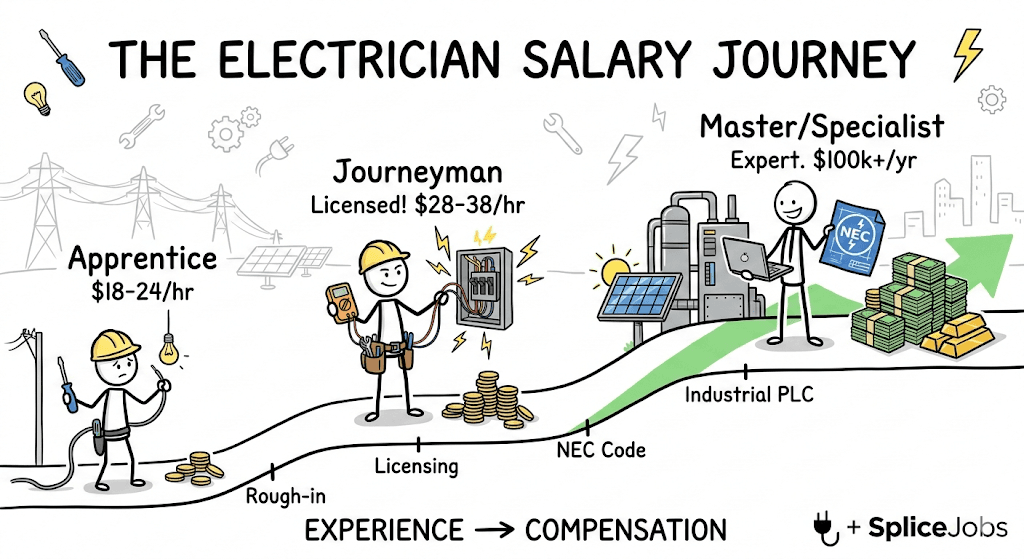
Apprentices: The learning phase is fully paid, though starting rates reflect your entry level status. First and second year apprentices typically make between $18 and $24 an hour in the US. You are mastering the basics of rough in work, safe tool handling, and material staging. Many apprentices find top tier training programs through the Electrical Training Alliance.
Not officially an apprentice yet? Many tradesmen cut their teeth at the very bottom of the ladder. If you are looking to break into the industry with zero experience, read our deep dive on Electrician Helper Jobs: Duties & Salary Expectations to learn exactly what the daily grind entails and how it serves as the ultimate stepping stone to a formal apprenticeship.
Journeyman Electricians: Once you pass your state or provincial licensing exam, your pay jumps significantly. Journeymen can work independently and troubleshoot live circuits safely. Expect to earn between $55,000 and $80,000 annually. You will also be expected to own a premium suite of professional hand tools and reliable testing equipment, such as an industry standard Fluke digital multimeter.
Master Electricians: Masters pull permits, run large commercial crews, and design blueprints from the ground up. Earning potential here easily exceeds $100,000 per year. Your mastery of load calculations makes you the most valuable asset to any large scale contracting firm.
Let us talk about the money you are leaving behind on the jobsite. You can wire a complex three phase motor control system in your sleep. You know the National Electrical Code backward and forward, and your conduit bends are flawless. But when it comes time to sit down with a project manager and discuss your pay rate, you suddenly lose your voice. This is the single biggest mistake skilled tradesmen make. If you want a complete breakdown on how to demand what you are worth confidently, you need to study our definitive guide on electrician salary negotiation.
High-Paying Sectors and Specialized Environments
Pulling residential wire provides a steady paycheck, but specializing in technical niches is the fastest route to a higher tax bracket. If you know how to handle complex electrical systems, employers will aggressively bid for your services.
Industrial Environments: The way industrial electricians work is vastly different from residential crews. Working in manufacturing plants or water treatment facilities requires deep knowledge of three phase power, motor controls, and programmable logic controllers. These highly technical roles frequently offer base salaries well over $85,000. Many of these premium roles are represented by organizations like the International Brotherhood of Electrical Workers.
Renewable Energy Installers: Solar array integration, battery storage systems, and commercial EV charger installations are booming. Specialists in this sector are seeing wages grow exponentially.
Powerline Technicians: Working on high voltage transmission lines carries extreme risk. Because of the inherent danger, lineworkers must follow strict guidelines set by the Occupational Safety and Health Administration to prevent fatalities. They are often the highest paid professionals in the sector, clearing massive figures with storm response bonuses.
Actionable Strategies to Scale Your Income
If you want to push your income to the upper limits of the SpliceJobs salary data, you need to treat your career like a business.
Acquire Niche Certifications: A standard journeyman card is just the foundation. Getting certified in fire alarm systems, specialized instrumentation, or high voltage splicing makes you a rare commodity.
Invest in Efficiency: Speed equals money. High quality wire strippers, laser levels, and reliable cordless power tools reduce fatigue and increase your daily output.
Target Prevailing Wage Projects: Government-funded projects require contractors to pay a prevailing wage, which is often significantly higher than standard commercial rates and includes robust fringe benefits.
The electrical field offers one of the most reliable and lucrative career paths in the modern economy. Stay sharp, keep your codebook updated, and never stop refining your troubleshooting skills. Ready to see what your specific expertise is actually worth on the open market? Create a profile on SpliceJobs and browse the latest high paying electrical opportunities in your exact region today.