Electrician Helper Jobs: Duties & Salary Expectations

SpliceJobs Team
Published on 4/7/2026
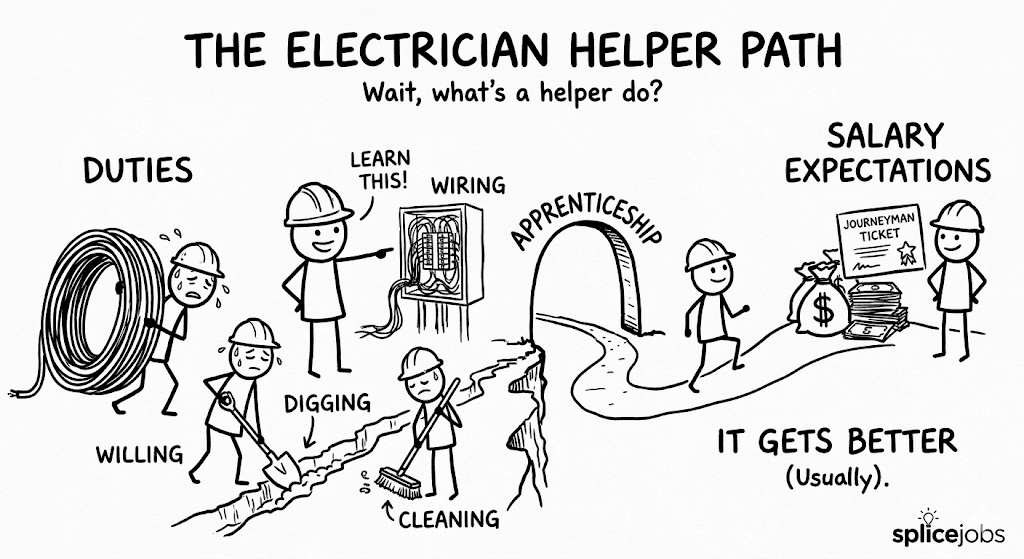
Hey SpliceJobs community. If you are lurking here trying to figure out how to break into the electrical trade, you have probably seen countless job postings for an "Electrician Helper." A lot of green hands ask what this role actually entails. Is it just sweeping floors and fetching coffee? How much does it realistically pay? Most importantly, will it actually lead to a legitimate apprenticeship?
Today we are breaking down the reality of working as an electrical helper. This is your practical, fluff-free guide to the daily duties, the necessary grit, and the salary expectations you should have before you ever set foot on a job site. Let us dive into the details.
The Gritty Reality: What You Will Actually Do All Day
Do not expect to be landing on a commercial site and bending perfect saddles in rigid conduit on your first day. As a helper, your primary job is to make the journeyman electrician more efficient. You are the logistical backbone of the immediate crew.
Your day-to-day duties will heavily revolve around material management. You will be unloading trucks, organizing the gang box, and hauling heavy spools of THHN or MC cable across job sites. When it is time to run wire, you are the one feeding the cable while the journeyman pulls, or you are manning the fish tape. Physical endurance is a massive part of this role. You will frequently find yourself digging trenches for underground service feeds. Because of the physical hazards involved in this type of labor, familiarizing yourself with OSHA standards for trenching and excavation is highly recommended for your own safety. Furthermore, proper lifting techniques are critical, so reviewing the NIOSH lifting guidelines can save your back during those long shifts.
Site cleanup is another undeniable reality. Keeping the work area clear of debris, conduit scraps, and stripped wire insulation is a safety mandate, not just busywork. A clean site prevents trip hazards and keeps the crew moving fast.
The Starter Pouch: Tools and Mental Preparation
You do not need a three-thousand-dollar tool setup to start, but showing up empty-handed is a fast way to get sent home. A good helper anticipates the next move. When the journeyman reaches for a tool, you should already have it ready.
Your initial tool pouch should include the basics: a solid pair of linesman pliers, quality wire strippers, a tape measure, a level, and a set of insulated screwdrivers. You are not doing hot work, but safety is paramount. You will quickly need to learn the codes and safety practices governing the trade. A great starting point is understanding the basic safety protocols outlined by the National Fire Protection Association (NFPA) 70E, which governs electrical safety in the workplace. For those wanting to get ahead on electrical theory and National Electrical Code knowledge during their off-hours, educational forums like Mike Holt Enterprises are goldmines of free information.
Breaking Down the Pay: SpliceJobs Salary Data
Let us talk money. Being a helper is an entry-level position, meaning the pay reflects your status as a trainee. However, the trades pay you to learn, which beats going into debt for a degree.
Based on our recent internal SpliceJobs data gathered from contractor postings across the United States, the national average for an electrician helper falls between $16.00 and $21.00 per hour. Your specific starting wage depends heavily on your location and the type of contractor you work for.
If you are working non-union residential jobs in states with lower costs of living, expect to start on the lower end of that spectrum. However, if you are looking at major metropolitan areas in states like New York, Illinois, or California, starting wages can easily push past $22.00 an hour. To verify regional prevailing wages and job growth projections, the Bureau of Labor Statistics provides excellent, up-to-date economic data.
There is also a notable difference between union and non-union shops. Getting hired as a helper or "CW" (Construction Wireman) in a union environment often comes with structured pay scales. You can research local union chapters and their specific pay structures through the International Brotherhood of Electrical Workers (IBEW). On the non-union side, large commercial contractors associated with groups like the National Electrical Contractors Association (NECA) often offer competitive starting wages and rapid review cycles for helpers who show up on time and work hard.
Stepping Up: The Bridge to Apprenticeship
The ultimate goal of a helper job is not to stay a helper. This role is a prolonged job interview for an apprenticeship. Contractors use the helper position to weed out individuals who lack the work ethic or mechanical aptitude for the trade.
If you prove yourself over three to six months, a good contractor will sponsor your apprenticeship. This is where your career truly begins. You will start logging official hours toward your journeyman ticket and attending classroom training. If you are navigating this transition, the federal Apprenticeship.gov portal is an incredible resource for understanding the legal structures of registered apprenticeships.
For those looking at union pathways, the Electrical Training Alliance dictates the rigorous standards and curriculum you will follow once you transition from helper to apprentice. Alternatively, many non-union shops utilize standardized curriculum and credentialing through the National Center for Construction Education and Research (NCCER), which ensures your training as an apprentice is recognized nationally.
Being an electrician helper is not glamorous. It is exhausting, dirty, and demanding. But if you have the drive to show up early, listen closely, and work hard, it is the absolute best way to launch a lucrative, lifelong career in the electrical trades. Keep grinding, stay safe, and let us know in the SpliceJobs comments how your first week on the site goes.