Electrician Apprentice Salary Guide: What to Expect Year 1

SpliceJobs Team
Published on 3/7/2026
Welcome to the SpliceJobs career hub. Stepping into the electrical trade is one of the smartest professional moves you can make today. Unlike a traditional college route where you pay to learn, an apprenticeship allows you to earn a steady paycheck while mastering a highly respected craft.
What does a first-year electrical apprentice actually make? How do factors like your location, union affiliation, and daily job site responsibilities impact your bottom line? This streamlined guide unpacks everything you need to know about your year-one earning potential and how to maximize your paycheck from your very first day on the site.
The Baseline: First-Year Earnings Overview
When you begin your apprenticeship, you start at the ground floor of the pay scale. Typically, a first-year apprentice earns around 40% to 50% of a licensed journeyman's hourly rate. As you complete your required classroom hours and gain practical field experience, that percentage scales up predictably every single year.
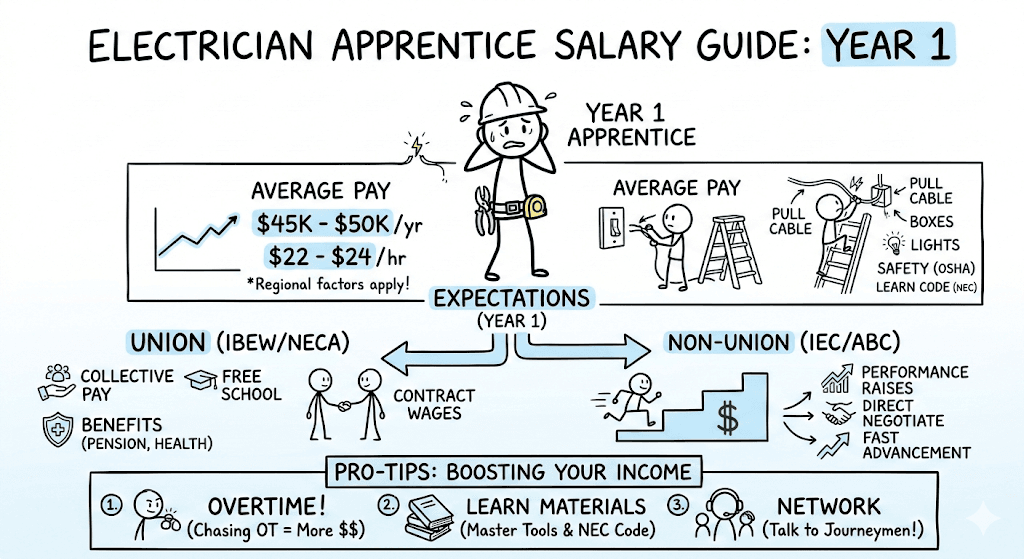
Based on current market data for 2026, the average annual salary for a first-year electrical apprentice in the United States ranges between $45,000 and $50,000. This translates to roughly $22 to $24 per hour. To see how these numbers align with broader national trends, you can review the latest insights from the Bureau of Labor Statistics. Keep in mind that these figures represent a national average. Your actual paycheck will fluctuate depending on a variety of local factors.
You can verify real-time job market numbers through our own SpliceJobs platform, check ZipRecruiter apprentice salary data, or review the latest Indeed salary reports for your specific county.
Regional Variations: Tracking Down the Best Wages
In the electrical trade, geography heavily dictates demand. High-cost-of-living areas and states with booming infrastructure projects tend to offer the highest starting wages.
States like Washington, Illinois, Oregon, and California lead the industry in starting pay. Apprentices working in major metropolitan hubs like San Francisco, Chicago, or Seattle frequently see starting wages pushing past $25 to $28 per hour. The heavy concentration of commercial development, tech data centers, and industrial facilities in these zones keeps contractors actively searching for new talent. For a deeper dive into regional construction economics, the Construction Coverage wage analysis provides excellent data on cost-of-living adjusted salaries.
Conversely, states in the South and Midwest might offer lower starting hourly rates, often landing in the $18 to $21 range. However, the significantly lower cost of living in these areas often balances out the difference in your gross income.
The Big Decision: Organized Labor Versus Independent Contractors
One of the most significant factors influencing your first-year salary is whether you join a union or work for a non-union merit shop. Both paths successfully lead to a journeyman ticket, but their compensation structures differ greatly.
Navigating the IBEW Route
The IBEW local chapters and the National Electrical Contractors Association, through the Electrical Training Alliance jointly manage union apprenticeships. If you choose this route, your wages are set by a strict collective bargaining agreement. You will know exactly what you will make in year one, year two, and straight through graduation.
Union apprentices receive robust, employer-paid family health insurance and pension contributions. You also get your schooling fully paid for. The main tradeoff is that getting accepted can be highly competitive and requires testing and interviewing.
Exploring the Merit Shop Path
If you prefer to get to work immediately, the non-union path is an excellent choice. Organizations like the Independent Electrical Contractors (IEC) and the Associated Builders and Contractors (ABC) sponsor fantastic apprentice training programs nationwide.
In a merit shop, your pay is negotiated directly with your employer. Raises are often tied to your personal performance, installation speed, and willingness to take on new responsibilities. While you might have to contribute to your own health insurance or retirement fund, highly motivated apprentices can sometimes climb the wage ladder much faster.
On the Job: Core Responsibilities and Safety
A first-year apprentice acts as the backbone of the job site support system. You will not be wiring complex motor controls or landing massive switchgear on day one. Your primary job is to be a sponge, follow directions carefully, and learn the fundamentals of electrical circuitry.
Typical daily duties include:
Unloading and organizing heavy material deliveries.
Pulling Romex or MC cable through wooden studs and metal conduit.
Digging trenches for underground electrical feeds.
Mounting device boxes and assembling complex lighting fixtures.
Keeping the work area completely clean and hazard-free according to OSHA safety standards.
You will be expected to show up with your own basic hand tools. Investing in quality gear is crucial for your success. Seasoned tradesmen recommend checking out Klein Tools educational resources to understand which tools will withstand daily job site abuse.
Furthermore, every piece of wire you pull must comply with the National Electrical Code (NEC) guidelines. To supplement your on-the-job learning, studying materials from experts like Mike Holt Enterprises will give you a massive head start in understanding the complex theory behind the code book.
Pro Tips to Increase Your Income Early On
Nobody wants to stay at the bottom of the pay scale forever. Here are actionable, trades-tested ways to boost your value to your electrical contractor:
Chase the Overtime: Construction schedules are notoriously tight. If your foreman asks for weekend volunteers to pull wire or prep a deck for a concrete pour, be the first to raise your hand. Time-and-a-half pay turns a decent paycheck into an outstanding one.
Master the Material: The fastest way to become invaluable is to know every fitting, strap, and breaker by name.
Network Constantly: Building a solid reputation for punctuality opens doors. Participate in active online communities like the Electrician Talk forums to learn from veterans across the country.
Stay Ahead of the Tech: Modern construction sites rely heavily on digital blueprints. Familiarizing yourself with software standards by reading the Procore construction software blog will make you a huge asset to older journeymen who might struggle with modern tablets.
Register Officially: Ensure you are properly registered with your state board and the Department of Labor apprenticeship portal. Logging your hours accurately is the only guaranteed way to secure your promotion to second-year status.
Advancing Beyond Year One
Surviving and thriving in your first year as an electrical apprentice comes down to a positive attitude, physical endurance, and a genuine willingness to learn. The starting salary of $45,000 to $50,000 is just the beginning of a lucrative journey. By your fourth or fifth year, you will be looking at a journeyman wage that easily clears the six-figure mark in many parts of the United States. Stay safe, ask detailed questions, and keep your tools sharp as you build your career.