What Is a Journeyman Electrician?

SpliceJobs Team
Published on 6/21/2026
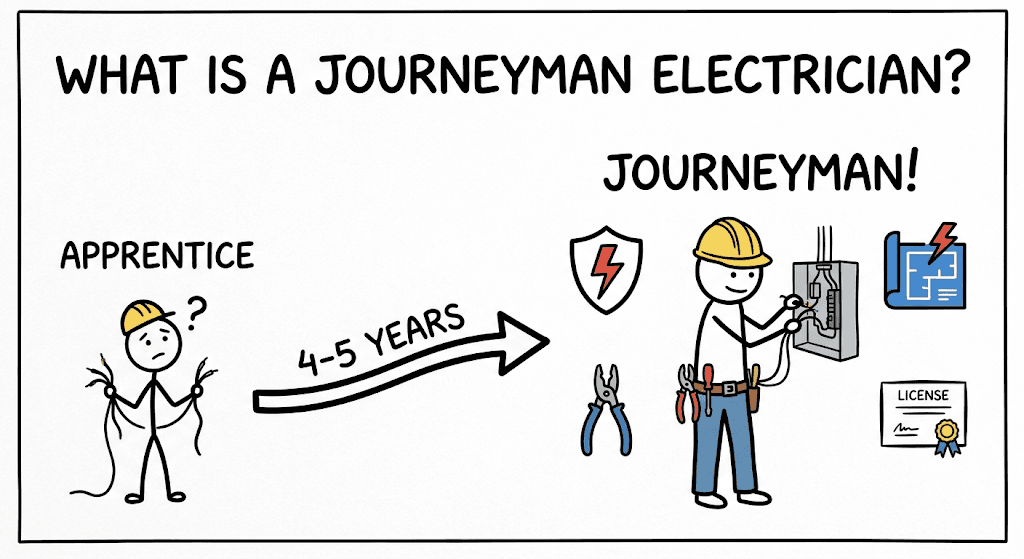
Anyone looking at the electrical trade quickly runs into the word "journeyman." It sounds like an old-school title, and honestly, it is. But in today's construction and service industries, getting your journeyman ticket is the most important milestone in your career.
When you reach this level, you are no longer a green apprentice holding a flashlight. You are a fully licensed professional who can work independently, solve complex wiring problems, and command a serious paycheck. If you are thinking about grabbing your linesman pliers and stepping into this field, you need to know exactly what this role looks like on a day-to-day basis.
The Journey to the Ticket
Becoming a journeyman is not something you do over a weekend course. It takes serious time, sweat, and brainpower. Most electrical workers spend four to five years as an apprentice before they can even apply for their journeyman test.
During this time, you are working full-time on job sites under the watchful eye of a licensed electrician. You start with the basics, like digging trenches, pulling Romex wire, and making up simple junction boxes. As you prove yourself, you move on to bending conduit, tying in service panels, and troubleshooting dead circuits.
But it is not just physical work. You also spend hundreds of hours in the classroom. You have to learn electrical theory, Ohm's Law, and how to navigate the National Electrical Code (NEC) or the Canadian Electrical Code (CEC). By the time you sit down for your state or provincial exam, you know the codebook front to back. Passing that test proves you have the chops to work safely and correctly without someone holding your hand.
Daily Life on the Job Site
So, what do you actually do once you have that card in your wallet? The daily routine of a journeyman electrician changes depending on the specific field you choose. However, the core responsibilities remain the same across the board.
First and foremost, you are responsible for reading and interpreting blueprints. You look at a set of plans and figure out the smartest and safest way to run power from the main panel to every switch, outlet, and motor in the building.
Core Job Duties
Here is a breakdown of the typical tasks you will handle on any given Tuesday:
Installing systems: Running wire, bending EMT (Electrical Metallic Tubing) or rigid conduit, and setting up cable trays in open ceilings.
Connecting power: Terminating wires at the breaker box, wiring up transformers, and ensuring all grounds and bonds are rock solid to prevent shocks.
Troubleshooting: When a motor stops working or a breaker keeps tripping, you are the person who has to find the problem. This means pulling out your digital multimeter and tracing the circuit until you find the short or the open neutral.
Code compliance: Ensuring every single wire nut, strap, and box fill meets strict local building codes. Safety is always the top priority.
Leading the crew: Journeymen are teachers. You will almost always have an apprentice working under you. It is your job to keep them safe, teach them the right way to strip a wire, and show them how to work efficiently.
Choosing Your Work Environment
Not all electrical work is exactly the same. Once you get your license, you often pick a lane that suits your skills and interests.
Residential Electricians
These folks focus entirely on homes. You might wire up brand-new custom houses or do service calls for older homes that need a panel upgrade. You will deal a lot with Romex (NM cable), wood framing, and crawling through attics or crawlspaces.
Commercial Electricians
If you like working in retail stores, office buildings, or schools, this is your spot. Commercial work involves a lot of metal framing. You will spend your days running metal conduit, pulling THHN wire, and working with heavier 3-phase power systems.
Industrial Electricians
This is heavy-duty work in factories, water treatment plants, and manufacturing facilities. You deal with massive motors, high voltage, and complex programmable logic controllers (PLCs). The stakes are high, but the work is incredibly rewarding for people who like complex puzzles and heavy machinery.
The Paycheck and Union Benefits
Let us talk about money. The biggest reason people push hard to pass their exam is the massive pay bump. When you transition from apprentice to journeyman, your hourly rate shoots up significantly.
In North America, a licensed journeyman earns a very comfortable living. While rates vary depending on whether you live in a high-cost city or a rural town, it is common to see wages that easily support a family, buy a home, and fund a solid retirement.
You also have to look at the union versus non-union side of things. Many electricians join the International Brotherhood of Electrical Workers (IBEW). Union journeymen typically work under a collective bargaining agreement. This guarantees a set hourly wage, excellent health insurance for your whole family, and a strong pension. Non-union (or open shop) electricians can also make great money, and they often have more flexibility to negotiate their own pay based on their specific skills and speed. Both paths offer steady work because the demand for skilled tradesmen is at an all-time high.
Equipping for Success
A good journeyman takes pride in their toolbelt. You cannot do the job right if you buy cheap gear. While contractors provide the big power tools and ladders, you are expected to carry your own hand tools.
A standard pouch includes heavy-duty linesman pliers, reliable wire strippers, a tape measure, a torpedo level, multiple screwdrivers, side cutters, and a non-contact voltage tester. Taking care of these tools is a mark of a true professional.
Moving Up the Ladder
Getting your journeyman license is not the end of the road. It is really just the beginning of a long and profitable career. After working as a journeyman for a few years, you can take another exam to become a Master Electrician.
A master license allows you to pull electrical permits with the city. At this stage, you can start your own electrical contracting business, hire your own crews, and bid on major projects. Other journeymen move into project management, estimating, or electrical inspection for the city.
Final Thoughts for Future Tradesmen
The electrical trade is not for the faint of heart. It requires a sharp mind, physical stamina, and a deep respect for safety. Electricity is invisible and unforgiving. But if you put in the time to learn the code, master your hand skills, and respect the craft, becoming a journeyman electrician gives you a golden ticket. You get job security, a great income, and the pride of building the infrastructure that keeps the lights on.
If you are ready to find an apprenticeship or your next big job as a licensed professional, check out the listings on SpliceJobs to take the next step in your career.