Is Energy Tech or Electrician the Easier Career Path?

SpliceJobs Team
Published on 7/4/2026
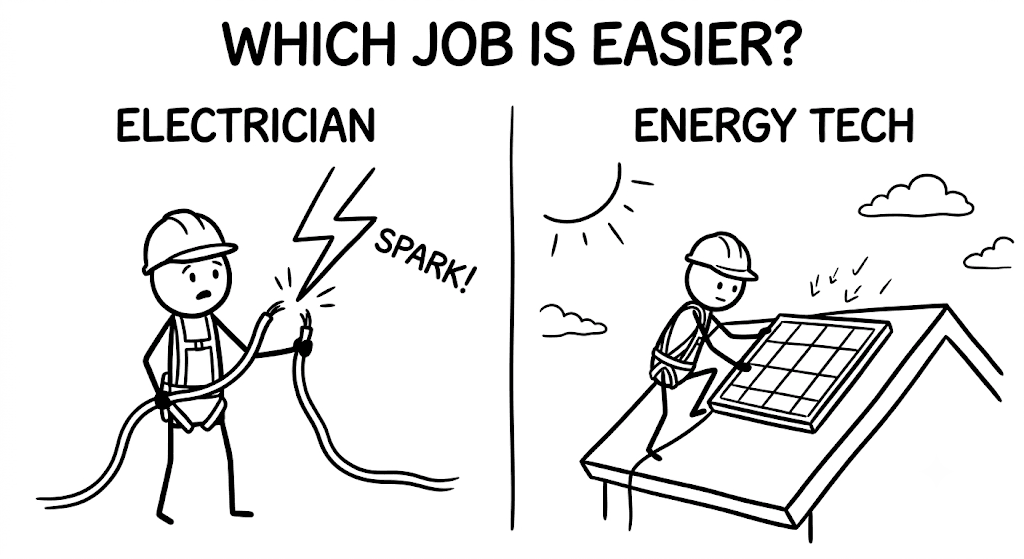
If you are looking to get into a hands-on career that offers solid pay and long-term job security, you have likely looked into becoming an electrician or an energy technician. Both roles are critical to keeping North America powered, but they require different skill sets, daily tasks, and physical demands.
When people ask which job is easier, the answer depends on what you consider hard. Are you more comfortable troubleshooting complex wiring diagrams under a strict building code, or would you rather manage mechanical systems and renewable energy hardware out in the elements?
Let’s break down the actual work, the learning curve, and the daily grind of both trades so you can figure out which path makes the most sense for your future.
Defining the Work: What Do They Actually Do?
To understand which job might be easier for you, it helps to understand what a typical Tuesday looks like in each field.
The Daily Grind of an Electrician
Electricians install, maintain, and repair electrical power, communications, lighting, and control systems. Whether working on residential new construction, commercial retrofits, or industrial plants, electricians must follow the National Electrical Code (NEC) in the US or the Canadian Electrical Code (CE Code) to the letter.
Core Tasks: Running conduit, pulling wire through walls, installing electrical panels, wiring outlets, and troubleshooting dead circuits.
Primary Tools: Multimeters, conduit benders, wire strippers, fish tapes, and cordless drills.
Working Environment: Often indoors or in covered structures, but frequently in tight spaces like crawlspaces, attics, or mechanical rooms.
The Daily Grind of an Energy Technician
Energy tech is a broader category. These professionals often specialize in heating, ventilation, and air conditioning (HVAC) systems, solar panel installations, wind turbines, or energy efficiency auditing. They focus on how buildings consume power and how green systems generate it.
Core Tasks: Installing solar arrays, servicing commercial HVAC units, calibrating smart thermostats, and performing energy audits to find system leaks.
Primary Tools: Manifold gauges, combustion analyzers, thermal imaging cameras, and basic hand tools like wrenches and screwdrivers.
Working Environment: Heavy outdoor exposure, particularly on rooftops for solar and HVAC work, or traveling between different residential and commercial properties.
The Apprenticeship and Learning Curve
Getting your foot in the door and earning your license looks very different for these two paths.
Electrician Training: A Strict, Regulated Path
Becoming a licensed journeyman electrician takes time and dedication. It is a highly regulated trade because mistakes can cause fires or fatal shocks.
The Timeline: A typical apprenticeship requires 4 to 5 years of on-the-job training, alongside roughly 144 hours of classroom learning each year.
The Math Factor: You do not need to be a calculus genius, but you do need to be comfortable with algebra and basic geometry to calculate voltage drops, circuit loads, and conduit bending angles.
The Licensing Exam: Passing the journeyman exam requires serious study time to navigate the codebook quickly under pressure.
Energy Tech Training: Faster Entry and Broad Skills
Energy technicians often have a shorter, more flexible route to a steady paycheck.
The Timeline: Many energy techs start with a 6-month to 2-year certificate program from a trade school or community college. Apprenticeships exist, but they are often shorter or less strictly regulated than electrical ones.
The Learning Curve: You need to understand thermodynamics, basic electrical circuits, and mechanical systems. It is broad knowledge rather than the deep, hyper-specific code knowledge required of an electrician.
Certifications: Instead of one massive state license, energy techs often pick up smaller, stackable certifications, like the EPA Section 608 for handling refrigerants or North American Technician Excellence (NATE) certifications.
Physical Demands and Safety Risks
Every trade takes a toll on the body, but they do it in different ways.
Factor | Electricians | Energy Technicians |
Physical Strain | Constant overhead reaching, kneeling, and working in cramped spaces. | Heavy lifting of compressors, climbing tall ladders, and working on sloped roofs. |
Weather Exposure | Mostly indoors once a building is framed, though unheated/uncooled. | High exposure to extreme heat and cold, especially on roofs or outdoor units. |
Safety Hazards | High risk of electrical shock, arc flashes, and falls from ladders. | Risks include refrigerant burns, falls from heights, and working around rotating machinery. |
If you hate working in the blazing summer sun or freezing winter wind, the electrician path is generally easier on your body in terms of climate exposure. However, if you hate squeezing your body into tiny attic access holes, energy tech might feel more comfortable.
Compensation and Career Longevity
Both fields offer excellent paths to a middle-class income or a successful business ownership career, but the earning ceiling tends to favor one side.
Electrician Pay and Union Options
Because of the high barrier to entry and strict licensing, electricians are highly valued. Union backing through the IBEW (International Brotherhood of Electrical Workers) is strong across North America, ensuring excellent benefits, pension plans, and structured pay scale increases as you move from apprentice to journeyman.
Energy Tech Versatility
Energy technicians might start making decent money faster due to shorter schooling, but the average top-end wage for a standard technician is often slightly lower than a specialized commercial or industrial electrician. However, the rapidly growing green energy sector offers massive growth potential for techs who specialize in solar grid integration or automation systems.
The Verdict: Which One is Easier?
Choose Electrician If: You prefer a highly structured career path, enjoy deep problem-solving, want strong union representation, and would rather master a specific codebook than deal with a mix of plumbing, heating, and roofing work.
Choose Energy Tech If: You want to get through school and onto a job site quickly, enjoy working outdoors, want variety in your daily tasks, and like the idea of working with modern green technologies.
Ultimately, being an electrician is harder on the mind due to strict codes and electrical theory, while being an energy technician is often harder on the body due to weather exposure and heavy equipment lifting.
If you are ready to find your next opportunity in the trades, check out the latest job openings and apprenticeship listings on SpliceJobs for electrical opportunities.