Electrician Industry Outlook in 2026

SpliceJobs Team
Published on 2/21/2026
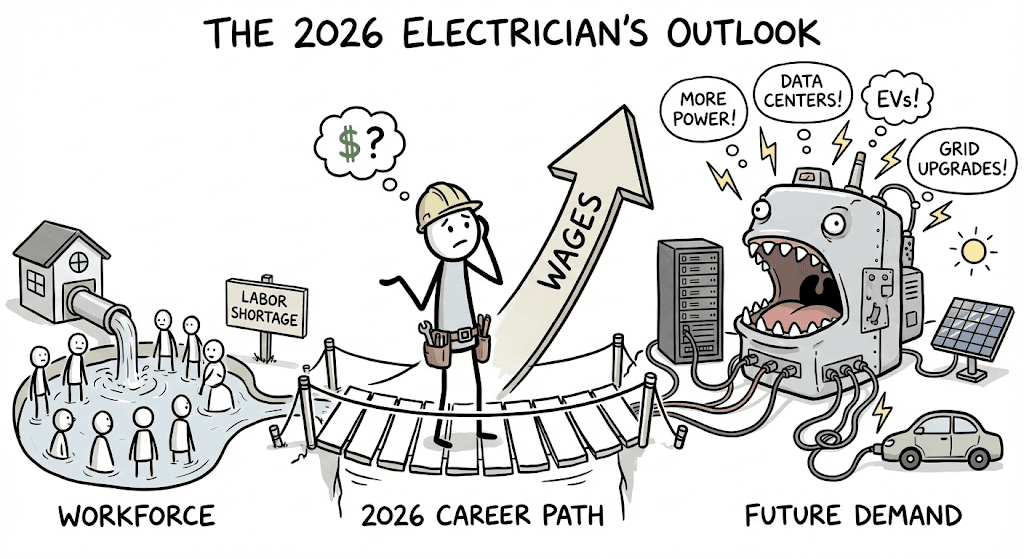
Welcome to the electrical trade in 2026. If you hold a journeyman card today, you possess one of the most valuable economic credentials in North America. We are looking at a landscape where the demand for skilled hands has completely outpaced the available labor pool.
At SpliceJobs, we analyze the hard data driving the skilled trades. The era of predictable and slow-paced growth is over. We have entered a period of rapid modernization, and the electrician is the most critical player on the field. This comprehensive outlook breaks down exactly where the industry is headed, the specific technologies fueling this massive demand, and how you can position your career for maximum success.
The Macro Shift in Power Generation and Distribution
The entire construction industry is currently pivoting toward heavy commercial, industrial, and utility-scale projects. We are witnessing massive financial investments in new power generation facilities across the continent. Whether you are pulling heavy feeder cable at a nuclear power plant or terminating connections at a sprawling commercial solar farm, the need for specialized electrical workers is unprecedented.
We are also in the middle of a historic and necessary overhaul of the electricity grid. Aging infrastructure requires immediate upgrades, meaning thousands of miles of new high-voltage transmission lines must be strung and connected. This modernization effort directly impacts how we manage regional power grids.
To understand the scale of this work, you have to look at the massive federal push to overhaul these networks. Programs like the Grid Modernization Initiative are actively working across the U.S. Department of Energy to create the modern grid of the future. There are also enormous federal grid deployment and financing projects aimed at upgrading existing infrastructure to handle clean energy goals. Researchers at the Pacific Northwest National Laboratory (PNNL) are constantly developing advanced controls to improve grid reliability and efficiency.
Utility contractors are actively seeking linemen and substation technicians who understand the specific demands of these massive networks. The eastern interconnected system operates across the eastern half of the continent, while the western interconnected grid handles the Pacific Coast and Rocky Mountain regions. Understanding how these massive networks share loads and maintain frequency is becoming a highly lucrative niche for utility-focused electricians.
High-Tech Infrastructure and the Data Center Boom
The aggressive buildout of hyperscale data centers requires highly specialized electrical contractors. These facilities consume power at levels equivalent to small cities. They demand the installation of massive switchgear and complex uninterruptible power setups to ensure vital servers never go dark. Preventing a catastrophic power outage at a server farm requires a deep understanding of redundant circuitry and automated transfer switches.
Furthermore, the continuous push for green energy integration means thousands of commercial and municipal projects are hitting the books every single month. Installing electric vehicle charging stations is no longer a small niche market. It is a massive, highly profitable sector of the trade. The widespread adoption of commercial electric vehicles requires upgrading local substations to ensure the regional power system can handle the intense, fluctuating electrical draw.
Advanced Tools, Safety, and Evolving Skillsets
The image of the traditional electrician is getting a high-tech upgrade. In 2026, turning a screwdriver and bending conduit are only half the job. You will be handling sophisticated electrical equipment daily. From sizing a massive industrial circuit breaker to diagnosing subtle faults in a complex commercial power supply, technical literacy is non-negotiable.
Electricians today must be highly comfortable working with smart inverters, specifically when converting DC to ac power on large-scale solar arrays. When handling our nation's electricity demands, contractors need workers who deeply understand both high-voltage distribution and low-voltage digital controls.
Safety protocols are simultaneously becoming much more stringent. Strict adherence to National Electrical Code updates and NFPA 70E standards for arc flash protection are absolute requirement. This standard details exactly how to protect workers from the heat of electric arc exposures and provides a practical safe working area. Before opening a panel, understanding the proper shock boundaries and executing a detailed risk assessment is mandatory, as outlined in Meltric's breakdown of risk assessment protocols. The contractors winning the best bids are those with impeccable safety records and crews wearing appropriate PPE, which you can learn more about in Black Stallion's guide to electrical safety.
Financial Leverage and the Skilled Labor Deficit
You cannot accurately discuss the 2026 electrical outlook without addressing the severe skilled labor shortage. A massive portion of the veteran workforce is retiring, and the pipeline of new apprentices is not large enough to replace them. This deficit is a long term reality that provides incredible leverage for workers.
According to the Bureau of Labor Statistics occupational outlook, the employment of electricians is projected to grow by 9 percent from 2024 to 2034, which is much faster than the average for all occupations. They project an average of 81,000 openings for electricians each year over that decade. Industry analysts highlight this urgency in ABLEMKR's 2026 labor report, noting that the labor gap is a real constraint on project timelines and profitability.
This shortage is not isolated to the United States. Statistics Canada's shortage data shows consistent demand for tradespeople, and provincial forecasts, such as Job Bank Canada's provincial outlooks, frequently highlight major industrial and commercial projects driving employment growth.
Wages in the electrical trades are rising rapidly due to this demand. Experienced journeymen and master electricians can essentially write their own tickets. This leverage opens up incredibly diverse career paths for those willing to learn.
Apprentices: First-year apprentices are seeing higher starting rates and better signing incentives as shops aggressively compete for fresh talent.
Journeymen: Base pay across major metropolitan areas is extremely competitive. The real financial windfall comes from abundant overtime and lucrative per diem offers on remote industrial mega-projects.
Contractors: Business owners have the luxury of being highly selective. You can bid higher margins on the complex projects you actually want to take.
Securing Your Place in the Future of the Trade
The electrical industry in 2026 is defined by limitless opportunity. However, capturing that opportunity requires strategic thinking and continuous professional development. You must continuously update your certifications to stay ahead of the curve. Gaining specialized knowledge in fiber optics, programmable logic controllers, or high-capacity EV infrastructure will put you at the absolute top of the pay scale.
Furthermore, you must protect your physical health. The work is physically demanding. Invest in high-quality ergonomic hand tools, wear proper protective equipment, and practice safe lifting techniques. You cannot enjoy these high industry wages if you are sidelined with a preventable injury.
The future belongs to the electricians who embrace new technology and master the fundamentals. The work is abundant, the money is exceptional, and the trade is commanding a completely new level of professional respect.